

Vintage year variation in private equity fund performance is a fact of the asset class, not a flaw. The secular case for PE as a superior form of equity ownership remains intact: PE owner‑managers consistently achieve higher growth by deploying operational levers more effectively than their public peers. Buyout firms generate operational alpha in many ways: by structuring management incentives more closely aligned with owners, avoiding quarter‑to‑quarter earnings management, bringing execution focus and discipline, replacing underperforming CEOs more quickly and much more. All these actions reduce dependency on market forces and have enabled higher returns over longer holding periods.
Investor disillusionment with PE is spreading. Fund performance—as measured by IRR—recently dipped below its historic mid‑teens average (see Exhibit 1, left side). The velocity of distributions to limited partners (LPs) has slowed meaningfully from its historical pace (see Exhibit 1, right side). Fundraising has decelerated, and some managers are extending fund lives or using continuation vehicles, which has drawn increased LP scrutiny.
While many investors still view PE as a core strategic allocation, doubts linger beneath the surface. Is the secular case for the asset class in question? Is the current gloom overdone? Should investors expect a comeback? If so, when?
As pioneers and leaders in sponsor finance, and with our longstanding participation in the PE ecosystem, we believe it’s time to pause and reconsider the long‑term case for the asset class, which we believe remains intact.
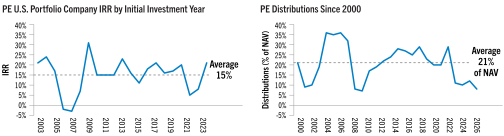
Source (left chart): Cambridge Associates. Data as of December 31, 2024. Based on data compiled from 13,429 portfolio investments made by funds in the initial investment years, 2003–2023. IRRs are gross of fees, expenses and carried interest. Initial investment‑year IRR requires multiple years of cash flow and realizations to be comparable. Recent vintages (e.g., 2024) remain immature and are therefore excluded or treated as preliminary by Cambridge Associates.
Sources (right chart): Burgiss, Hamilton Lane. Data through September 2025 (annualized).
To make the secular case for PE, it helps to revisit its origins. In the late 1970s, the leveraged buyout emerged as a new form of company ownership.1 These novel entities had no public shareholders and were not traded. Instead, they used private (and public) debt as a source of capital, with equity provided by long‑term, locked‑up partnerships funded by institutional LPs. This wasn’t just a financing innovation; it offered an alternative to the public corporation and to investing in public equity markets.
To be clear, this origin story predates today’s critique of public companies, which tends to focus more exclusively on the cost and burdens of a public listing: armies of compliance professionals, seemingly arbitrary valuation forces (including liquidity‑driven volatility), the tired choreography of quarterly earnings calls and the enforced myopia in managing short‑term growth expectations. The oft‑referenced “halving of U.S. publicly listed companies” over the last two decades, particularly since the Sarbanes–Oxley Act, underscores the strain (see Exhibit 2). But the original argument favoring PE had a different set of prompts.
Its prime mover, Michael Jensen, identified the “central weakness” of the public firm as the tendency of company management (the “agents” of shareowners) to misallocate cash flows.2 This “agency cost” was evident in managers’ temptation to divert cash flows for potentially excessive payouts to shareholders or sub‑optimal internal projects, both of which were value‑eroding.
PE offered a different model built on acquisition financing. Under this model, buyout debt is absolutely central. Sponsor finance does more than fund deals—it creates discipline and reduces agent misbehavior commonly found in public companies. By committing future cash flows to lenders, firms take on strict performance obligations and are compelled to operate with efficiency. It effectively “bonds” the firm’s promise to pay out a portion of future cash flows, giving lenders the right to take control if the promise isn’t kept.3
This “control effect” of debt reshaped governance and capital structures, giving rise to the leveraged buyout model. By hardwiring discipline into the system, PE ownership promised—at least in theory—more efficient management and stronger alignment between capital and performance. The question now is whether that promise holds: How well do private firms measure up against public peers? To answer that, let’s first break down the value drivers of PE performance.
The Number of PE-Backed Companies vs. Publicly Listed Companies
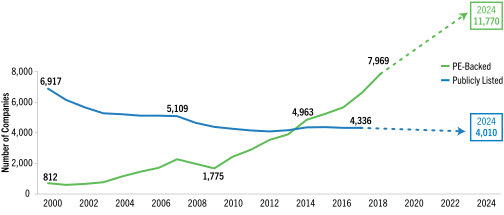
Sources: For publicly listed companies, data was sourced from World Federation of Exchanges for the U.S. only. This includes a combination of companies listed on NYSE and Nasdaq, excluding investment funds, ETFs and holding companies. For PE-backed companies, data was sourced from Pitchbook, excluding venture capital, for the U.S. only. Data as of December 31, 2025.
PE returns are often attributed to three drivers: leverage, multiple expansion and operational improvement. The effects of leverage and multiples are largely market‑driven. The agency argument hinges not on what markets do, but on what agents and operators do. Gains in operational efficiency should be the key factor in the argument for PE’s secular appeal.
Reviewing the long history of PE value creation, from 1984 through 2018, and using a multiple of investor capital (MOIC) as the basis for performance measurement, we can see that operational improvement contributed most (0.7x, or nearly half of the 1.6x total gains over that period). Multiple expansion plays a modest role (0.3x), and leverage contributes a bit more (0.6x). But these individual contributions tend to vary over time, sometimes dramatically over distinct periods (see Exhibit 3, left and right sides).
The cynical adage that PE managers made money by “levering up” acquired firms had some justification in the earliest days of the asset class (pre‑2000). But its role has declined continuously since then, making up just one quarter of total growth in the most recent period in the study (2008–2018).
Given their natural tie to interest rates, multiples varied the most, from ‑12% in the earliest period to a high of 28% over the last decade of the study. Operational drivers, by contrast, have been consistently dominant, accounting for 42% of PE value creation over the full life of the analysis with minimal variance over time (37–47%).
Peeling back a layer, we find revenue growth is the largest driver of operational enhancement, making up 36 percentage points of its full 42% contribution. This explains the importance of “control” equity—the ability of PE operators to influence investment outcomes.
In the next section, we will compare the performance of publicly listed and PE‑backed firms based on revenue growth and EBITDA margin.4
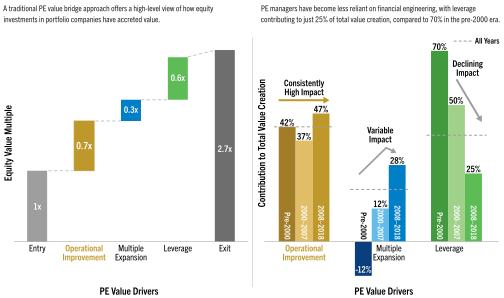
Source: Institute for Private Capital. Data sample includes 2,951 fully exited deals from 1984–2018, with around $945 billion USD in combined equity investments and around $3.19 trillion USD in total enterprise value based on a StepStone Group proprietary dataset of private transactions. “Pre‑2000” comprises 277 deals from 1984–1999. “2000–2007” comprises 1,500 deals from 2000–2007. “2008–2018” comprises 1,179 deals from 2008–2018. Data as of January 2022.
Are buyout firms better at generating operational improvement than their public peers? The evidence says yes. Over the years, PE‑backed companies have delivered 12.4% annualized revenue growth vs. 5.9% for public companies, an average annualized advantage of 6.5 percentage points (see Exhibit 4, left side).
PE‑owned businesses also operate at consistently higher EBITDA margins than public peers, a structural advantage that has persisted across macro environments since 2010 (see Exhibit 4, right side). This margin advantage underscores the operational discipline and governance rigor that define PE ownership.
While many factors contribute to the overall effect, talent and incentives are at the heart of it. Well before a deal closes, PE firms identify and back “fit for purpose” managers tasked with shaping and tracking revenue targets tied to new product development, geographic expansion and broader corporate strategy. This extends to board governance, where private company directors (often drawn from the buyout firm itself) work longer and far more actively than their public counterparts, bringing a “relentless focus on value‑creation levers.”5 They lead strategy, set KPIs and monitor executives with a focus on cash metrics and speed of delivery. Public boards, by contrast, tend to prioritize risk mitigation (particularly risk of embarrassment).
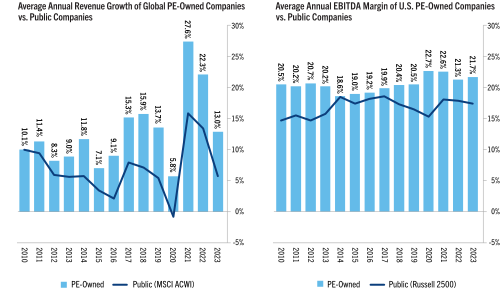
Sources (left chart): Cambridge Associates LLC Private Investments Database (as reported by investment managers), FactSet Research Systems and MSCI Inc. Data as of December 31, 2023.
Sources (right chart): Cambridge Associates LLC Private Investments Database (as reported by investment managers), FactSet Research Systems and Frank Russell Company. Data as of December 31, 2023.
We find that the operational impact on newly acquired firms is even greater with buyout managers who develop sector‑specific specialist expertise. Their veteran sector specialists bring deep domain knowledge, extensive professional networks and repeat experience to drive performance. Their advantages include:
These capabilities translate into measurable performance, with firms that adopt a specialist approach across distinct industry verticals consistently delivering higher median IRRs and MOICs (see Exhibit 5). They also have higher highs (that is, a larger percentage of 3x MOIC portfolios) and fewer lows, with the ability to navigate sector‑specific downturns while sustaining returns.
This specialist alpha, rooted in operational advantage, creates a more stable, repeatable performance profile. And in our experience, buyout managers with this specialist bent tend to seek out private lenders with whom they match up well—lenders with analogous expertise. This shared DNA between lender and borrower has fostered many of our most powerful long‑term partnerships, with a history of repeat financings.
IRR and MOIC Comparison by Sector: Specialists vs. Generalists
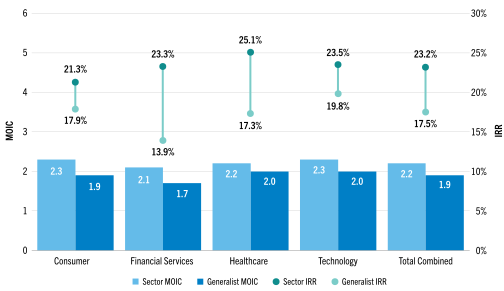
Source: Cambridge Equity Research. “Declaring a Major: Sector-Focused Private Investment Funds,” November 11, 2014. The period studied covers a 10-year time period, from 2001 to 2010. A similar analysis was conducted in December 2024 by Common Fund covering 15 years of PE performance, from 2006 to 2020, and showed fundamentally similar results.
It’s true that there are some periods when PE has lagged public equity markets. But these have been relatively rare and are typically followed by strong rebounds.
Exhibit 6 shows the rolling one‑year relative return of private vs. public equity. There were only a small handful of intervals over the past 25 years when the returns of public stocks exceeded those of PE. In almost 90% of these rolling periods, PE outperforms, underscoring its long‑term value and the importance of staying invested across cycles. This analysis suggests at least one interpretation: Today’s environment may present an attractive entry point to initiate or increase an allocation.
In our view, the secular case for PE remains compelling. We believe the structural advantages of PE ownership and the emphasis on operational edge through deep sector expertise position the asset class for secular outperformance. Investors who remain focused on long‑term value creation may be well positioned to benefit from the next wave of growth.
PE Underperforms Rarely, Then Comes Back Strong
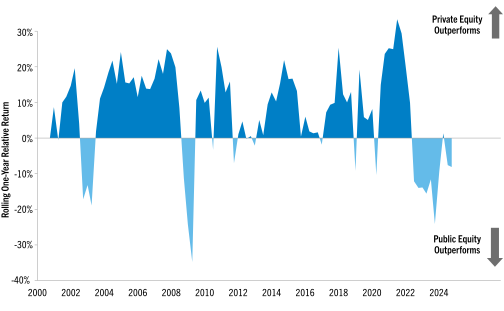
Sources: Public Equity from MSCI ACWI via Bloomberg. PE from Preqin Private Capital Indices. Data through September 30, 2025.
1. Kohlberg, Kravis Roberts (1976), Thomas H. Lee Co. (1974), Clayton and Dubilier (1976), among others.
2. Michael Jensen, “Eclipse of the Public Corporation,” Harvard Business Review, September–October 1989; also “Agency Costs of Free Cash Flow, Corporate Finance, and Takeovers” by Michael Jensen, American Economic Review, May 1986, vol. 76, no. 2, pp. 323–329.
3. It’s worth noting that during the period in which Jensen was writing, debt played a larger role in acquisition financing, typically covering up to 80% of the transaction cost. Today, that figure is generally in the 40–50% range.
4. The other portion of this metric, growth in EBITDA margin ranged from 6% to 2% to 10% over the three different periods of the analysis, for a total contribution of six percentage points to the 42% total.
5. “The Voice of Experience: Public vs. Private Equity,” in The McKinsey Quarterly, December 2008. Private company directors spend, on average, nearly three times as many days on their roles as those at public companies (54 vs. 19).
In this document, the terms “Golub Capital” and “Firm” (and, in responses to questions that ask about the management company, general partner or variants thereof, the terms “Management Company” and “General Partner”) refer, collectively, to the activities and operations of Golub Capital LLC, GC Advisors LLC (“GC Advisors”), GC OPAL Advisors LLC (“GC OPAL Advisors”) and their respective affiliates or associated investment funds. A number of investment advisers, such as GC Investment Management LLC (“GC Investment Management”), Golub Capital Liquid Credit Advisors, LLC (Management Series) and OPAL BSL LLC (Management Series) (collectively, the “Relying Advisers”) are registered in reliance upon GC OPAL Advisors’ registration. The terms “Investment Manager” or the “Advisers” may refer to GC Advisors, GC OPAL Advisors (collectively the “Registered Advisers”) or any of the Relying Advisers. For additional information about the Registered Advisers and the Relying Advisers, please refer to each of the Registered Advisers’ Form ADV Part 1 and 2A on file with the SEC. Certain references to Golub Capital relating to its investment management business may include activities other than the activities of the Advisers or may include the activities of other Golub Capital affiliates in addition to the activities of the Advisers. This document may summarize certain terms of a potential investment for informational purposes only. In the case of conflict between this document and the organizational documents of any investment, the organizational documents shall govern.
Information is current as of the stated date and may change materially in the future. Golub Capital undertakes no duty to update any information herein. Golub Capital makes no representation or warranty, express or implied, as to the accuracy or completeness of the information herein.
Views expressed represent Golub Capital’s current internal viewpoints and are based on Golub Capital’s views of the current market environment, which is subject to change. Certain information contained in these materials discusses general market activity, industry or sector trends or other broad-based economic, market or political conditions and should not be construed as investment advice. There can be no assurance that any of the views or trends described herein will continue or will not reverse. Forecasts, estimates and certain information contained herein are based upon proprietary and other research and should not be interpreted as investment advice, as an offer or solicitation, nor as the purchase or sale of any financial instrument. Forecasts and estimates have certain inherent limitations, and unlike an actual performance record, do not reflect actual trading, liquidity constraints, fees, and/or other costs. In addition, references to future results should not be construed as an estimate or promise of results that a client portfolio may achieve. Past events and trends do not imply, predict or guarantee, and are not necessarily indicative of, future events or results. Private credit involves an investment in non-publicly traded securities which may be subject to illiquidity risk. Portfolios that invest in private credit may be leveraged and may engage in speculative investment practices that increase the risk of investment loss.
This presentation has been distributed for informational purposes only, and does not constitute investment advice or the offer to sell or a solicitation to buy any security. This presentation incorporates information provided by third-party sources that are believed to be reliable, but the information has not been verified independently by Golub Capital. Golub Capital makes no warranty or representation as to the accuracy or completeness of such third-party information. No part of this material may be reproduced in any form, or referred to in any other publication, without express written permission.
Past performance does not guarantee future results.
All information about the Firm contained in this document is presented as of April 2026, unless otherwise specified.
"*" indicates required fields

Dispersion & Persistence of Manager Performance in Direct Lending
Learn