

The Dividend Trap
Why Chasing Yield Can Lead Investors Astray
- White Paper
- Dividend yield is often emphasized by investors, yet the headline yield says more about a fund’s distribution policy than its ability to create economic value or investor wealth.
- Two direct lending funds with similar headline yields can deliver very different investor outcomes over time, driven largely by differences in the managers’ ability to avoid credit losses.
- Total net economic returns provide a clearer measure of manager performance than headline yield.
The allure of yield is powerful. Investors naturally gravitate toward it, often elevating yield above all other considerations as the clearest indicator of investment appeal. Yet, this fixation can lead to disappointing outcomes. Nowhere is this more evident than in the world of business development companies (BDCs), where dividend yield dominates marketing decks, analyst reports and investor screens. The reality is that dividend yield merely reflects a fund’s distribution strategy, not its earnings, and offers no insight into whether long‑term value is being created for shareholders. To truly understand BDC value, investors need to look beyond yield.
The Disconnect: Yield vs. Return
For income‑oriented investors, dividend yield often commands outsized attention, yet it offers little insight into the value a manager is actually creating. The problem is that dividend policy and fundamental value creation do not always move in lockstep. When payout decisions drift away from underlying fundamentals, headline yield becomes a misleading guide.
Let’s look at actual results from two publicly traded BDCs over the past three years. BDC “A” reported an average dividend yield of 11.7% on net asset value (NAV), while BDC “B” had a lower yield of 9.6%. If you were chasing yield, BDC “A” might seem like the obvious choice. But net returns tell a different story.
If we look at economic value creation (e.g., with starting NAV as our cost and dividends received and ending NAV as our return), BDC “B” delivered annual net return of 10.5%, double BDC “A’s” 5.2%. The promise vs. the performance is clear: dividend yield was a poor predictor of what investors actually earned. When a BDC’s earnings fall short of its dividend, fund NAV erodes; that is, the principal value of an investor’s capital declines. In this example, the higher yield on the screen masked underlying credit risk, ultimately eroding actual investor returns.
Exhibit 1
Promise vs. Performance
Three-Year Dividend Yield Compared to Annual Net Return
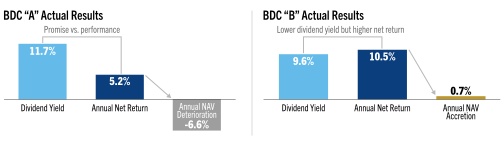
Source: Golub Capital internal analysis using data from KBW Research’s BDC database. Performance metrics were calculated over a three-year performance period from Q3 2022 to Q2 2025. Dividend yield is calculated as the average quarterly dividend yield over the period. Annual net return is calculated as the average economic return, defined as the BDC’s change in NAV per share plus total dividends per share received over the period divided by beginning period NAV per share. Annual NAV deterioration and accretion is calculated as the difference between the beginning and ending period NAV per share divided by the period.
Understanding BDC Dividend Yield
Let’s clarify what dividend yield means in the BDC universe. We define dividend yield as the annualized cash distribution of the fund divided by its NAV. The headline yield says nothing about the sustainability or quality of those payments. How a BDC manager chooses to fund its dividend, whether from genuine earnings or by returning capital, can have lasting consequences for shareholder value.
BDCs can fund dividends in several ways: through investment income or realized gains or, when those fall short, by returning shareholder capital. This last approach erodes NAV and reduces future earnings power. Conversely, a BDC that consistently earns more than it pays out can grow NAV and increase future earnings. Dividend yield alone doesn’t tell us how well the manager is performing. It simply reflects the fund’s capital distribution policy, which may be fully funded by earnings or underfunded, requiring some form of return of capital to sustain it.
Exhibit 2
Not All Dividends Are Created Equal
Dividend Funding (and De-Funding) Sources
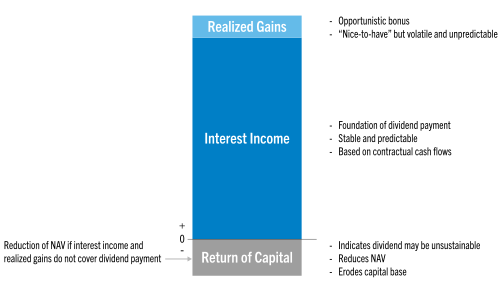
Source: Golub Capital.
What Really Drives BDC Returns
So, what should investors focus on when considering a BDC allocation? The answer is net returns. At their core, BDC net returns are driven by income and reduced by credit losses. The income return, before accounting for credit losses, is the primary support for the dividend. However, it is the management of credit losses that truly distinguishes manager skill and drives performance dispersion across BDCs.
Consider the actual results from publicly traded BDC “A.” Its income yield of 11.6% was roughly in line to support its dividend distribution of 11.7%. However, annual net credit losses of ‑6.4% cut deeply into performance, reducing net returns and eroding NAV by an amount nearly equal to those losses.
Managers who keep credit losses low are able to preserve NAV and protect shareholder capital. Net returns, not headline dividend yield, are the true measure of manager performance. Ultimately, a manager’s ability to minimize credit losses is what distinguishes superior performers from the crowd.
Exhibit 3
Credit Losses Distinguish Manager Skill and Drive Performance
BDC “A” Net Return Composition
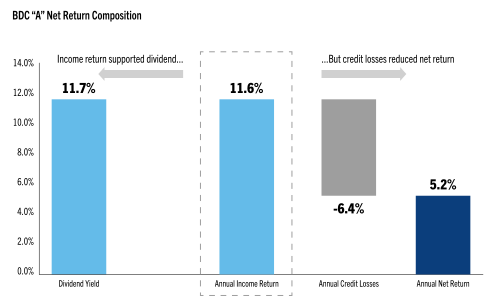
Source: Golub Capital internal analysis using data from KBW Research’s BDC database. Performance metrics were calculated over a three-year performance period from Q3 2022 to Q2 2025. Dividend yield is calculated as the average quarterly dividend yield over the period studied. Annual income return is calculated at the average quarterly net investment income return over the period. Annual credit losses are calculated as the difference between the annual net investment income return and net income return over the period. Annual net return is calculated as the average economic return, defined as the BDC’s change in NAV per share plus total dividends per share received over the period divided by beginning period NAV per share.
History Shows: Yield Is Not Predictive
One takeaway is to be cautious when assessing BDCs based solely on their dividend yield. Over the past three years, BDCs with both the highest yield and the lowest yield based on quartile dividend yields generated lower net returns. Some faced credit headwinds; others simply struggled to generate loans with sufficiently high spreads.
The strongest results were achieved by BDC managers who maintained sustainable dividend distributions while managing credit headwinds. Consistent outperformance has come from BDCs that strike a prudent balance, supporting dividends with genuine earnings rather than taking on excess risk or returning capital.
High dividend yields should be met with skepticism and a critical eye. Elevated yields could signal that managers are taking on greater credit risk to support above‑market payouts. This risk may not be obvious at first, but over time higher credit losses erode investor capital and undermine returns.
The lesson is clear: Sustainable results come from disciplined credit management and real earnings generation (after credit losses), not from chasing the highest yield.
Exhibit 4
A Balanced Dividend Approach Has Proven Successful
BDC Net Returns by Dividend Yield Quartile
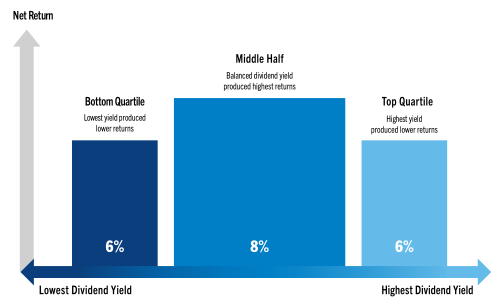
Source: Golub Capital internal analysis using data from KBW Research’s BDC database, which tracks the three-year return performance from Q3 2022 to Q2 2025. BDC net return is calculated as the BDC’s change in NAV per share plus total dividends per share received over the period divided by beginning period NAV per share. The data set excludes internally managed BDCs, venture lending BDCs and those with 25% or more equity exposure, resulting in a total of 32 BDCs. Past performance does not guarantee future results.
Disclaimer
In this document, the terms “Golub Capital” and “Firm” (and, in responses to questions that ask about the management company, general partner or variants thereof, the terms “Management Company” and “General Partner”) refer, collectively, to the activities and operations of Golub Capital LLC, GC Advisors LLC (“GC Advisors”), GC OPAL Advisors LLC (“GC OPAL Advisors”) and their respective affiliates or associated investment funds. A number of investment advisers, such as GC Investment Management LLC (“GC Investment Management”), Golub Capital Liquid Credit Advisors, LLC (Management Series) and OPAL BSL LLC (Management Series) (collectively, the “Relying Advisers”) are registered in reliance upon GC OPAL Advisors’ registration. The terms “Investment Manager” or the “Advisers” may refer to GC Advisors, GC OPAL Advisors (collectively the “Registered Advisers”) or any of the Relying Advisers. For additional information about the Registered Advisers and the Relying Advisers, please refer to each of the Registered Advisers’ Form ADV Part 1 and 2A on file with the SEC. Certain references to Golub Capital relating to its investment management business may include activities other than the activities of the Advisers or may include the activities of other Golub Capital affiliates in addition to the activities of the Advisers. This document may summarize certain terms of a potential investment for informational purposes only. In the case of conflict between this document and the organizational documents of any investment, the organizational documents shall govern.
Information is current as of the stated date and may change materially in the future. Golub Capital undertakes no duty to update any information herein. Golub Capital makes no representation or warranty, express or implied, as to the accuracy or completeness of the information herein.
Views expressed represent Golub Capital’s current internal viewpoints and are based on Golub Capital’s views of the current market environment, which is subject to change. Certain information contained in these materials discusses general market activity, industry or sector trends or other broad-based economic, market or political conditions and should not be construed as investment advice. There can be no assurance that any of the views or trends described herein will continue or will not reverse. Forecasts, estimates and certain information contained herein are based upon proprietary and other research and should not be interpreted as investment advice, as an offer or solicitation, nor as the purchase or sale of any financial instrument. Forecasts and estimates have certain inherent limitations, and unlike an actual performance record, do not reflect actual trading, liquidity constraints, fees, and/or other costs. In addition, references to future results should not be construed as an estimate or promise of results that a client portfolio may achieve. Past events and trends do not imply, predict or guarantee, and are not necessarily indicative of, future events or results. Private credit involves an investment in non-publicly traded securities which may be subject to illiquidity risk. Portfolios that invest in private credit may be leveraged and may engage in speculative investment practices that increase the risk of investment loss.
This presentation has been distributed for informational purposes only, and does not constitute investment advice or the offer to sell or a solicitation to buy any security. This presentation incorporates information provided by third-party sources that are believed to be reliable, but the information has not been verified independently by Golub Capital. Golub Capital makes no warranty or representation as to the accuracy or completeness of such third-party information. No part of this material may be reproduced in any form, or referred to in any other publication, without express written permission.
Past performance does not guarantee future results.
All information about the Firm contained in this document is presented as of April 2026, unless otherwise specified.

Crowded Market in Private Credit? Enter the Large, Public Alternative Managers
Learn