

A Short History of Sponsor Finance
The Evolution of Bank and Non-Bank Participation in Middle Market Lending
- Commentary
- How the rise of sponsor finance mirrors three decades of bank regulation and disintermediation.
- How increasing regulatory capital charges for banks that lend to levered companies created the opening for non-bank direct lenders to emerge and develop partnership-oriented relationships with buyout sponsors.
- How sponsor demands for speed, certainty, add-on flexibility and limited syndication established non-bank private direct lenders as the buyout industry’s lenders of choice.
A mix of regulatory, market and client-driven forces has pushed banks away from lending to private equity‑backed middle market companies, opening the door for non‑bank institutions to fill the gap. This paper explores the factors behind this historic shift and the coincident emergence of a deeply symbiotic relationship between private equity sponsors and private credit managers—one captured in the term “sponsor finance.”
The Long Arc of Bank Disintermediation
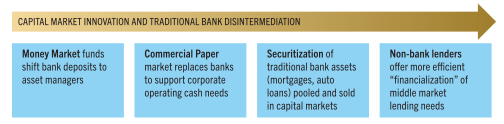
The diminishing role of banks in financial markets is not a new phenomenon. Over the past several decades, banks have experienced repeated waves of disintermediation, often prompted by both industry regulation and financial innovation in capital markets (see Exhibit 1). Consider some familiar examples:
- The rise of money market funds redirected trillions of dollars from bank deposits into more flexible, higher-yielding instruments in open-end fund structures.
- Large corporate issuers began bypassing bank loans in favor of commercial paper and capital market solutions for their operating cash needs.
- Securitization allowed traditionally bank‑held assets, such as mortgages and auto loans, to be pooled and sold in capital markets, offloading them from bank balance sheets.
This historical context is key to understanding the rise of private credit and sponsor finance. Importantly, the story is less one of revolution than evolution.
Exhibit 1
A History of Bank Disintermediation
Private Credit Is Just the Latest Example
Bank lending as a share of total borrowing has been falling for 50 years; increased regulation, financial innovation and advances in securitization have prompted more borrowers to bypass traditional banks.
Source: Golub Capital.
Factor 1: Three Waves of Regulation
While many factors have shaped the history of private credit, regulation has been a powerful and persistent force. Since the 1980s, three major waves of regulatory reform, typically following some idiosyncratic market crisis, have cumulatively reshaped how banks participate (or are hindered from participating) in lending (see Exhibit 2).
First Wave: Savings and Loan Crisis
Rising inflation and interest rates in the 1980s created a severe mismatch on bank balance sheets: The amount banks had to pay on short-term deposits climbed dramatically, while the income earned from long-term mortgage assets remained fixed. This set in motion a long period of bank consolidation: Nearly one-third of U.S. banks became insolvent from 1986-1995. Many local and regional lenders, a natural source of debt capital for middle market businesses across the U.S., were gradually replaced by a handful of national and global brands.
To stabilize the industry, regulators began instituting controls over bank balance sheets. The U.S. Federal Reserve and Office of the Comptroller of the Currency instituted a formal capital ratio for larger banks in 1981. Such regulatory-based capital requirements became the nexus of most future bank regulation.
The global extension of this approach came in 1988 with the Basel I Accord, which introduced the concept of risk-weighted assets, imposing higher capital requirements for riskier credit exposures. Loans used for financing leveraged takeovers fell into a highly penalizing 100% risk weight category, making them less attractive from a return-on-equity standpoint.
Exhibit 2
Three Waves of Market Stress and Regulatory Action Drive Banks to the Periphery of Private Credit
Three market disruptions (the savings and loan crisis; the dot-com bubble; the global financial crisis [GFC]) and the increasingly nuanced regulatory capital requirements that followed (in Basel and Dodd-Frank regulations) helped progressively drive banks out of the business of lending to middle market leveraged buyouts.
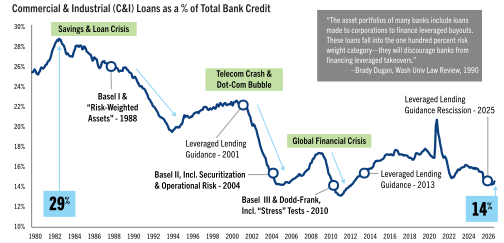
Note: In 2013, U.S. banking regulators issued the LLG, which outlined supervisory expectations for banks underwriting and holding leveraged loans, especially those with debt/Earnings Before Interest, Taxes, Depreciation, and Amortization (EBITDA) ratios above 6x. While this guidance did not impose hard limits or legally binding requirements, it signaled areas of heightened supervisory focus and encouraged banks to apply more conservative underwriting and risk-management practices, contributing to the post-GFC migration of leveraged lending activity to non-bank lenders. In December 2025, the OCC and FDIC formally rescinded this guidance, citing concerns about regulatory overreach and competitiveness. Although this move gives banks greater flexibility to an extent, the LLG was never viewed as a major binding constraint, and its rescission is unlikely to have a significant impact on market dynamics. Moreover, private credit managers have become a central part of the sponsor finance landscape, and any meaningful shift in market share could take time, as banks would need to rebuild the leveraged lending infrastructure that largely migrated away in the post-GFC era.
Source: The Federal Reserve database of Assets and Liabilities of Commercial Banks in the U.S. from H.8 filings and Golub Capital internal analysis. Data as of March 31, 2026.
Second Wave: Dot-Com Bubble (2000s)
The dot-com bubble and subsequent credit issues led banking agencies to issue new leveraged lending guidance (LLG) in 2001, highlighting the risks of leveraged financing, especially in the middle market. In 2004, Basel II expanded the regulatory screw‑tightening to include operational and securitization risk, further raising the cost of capital for certain types of leveraged lending. Notably, these rules applied only to regulated banks, not non‑bank lenders.
Third Wave: GFC (2008)
The 2008 GFC arguably brought the most transformative change, with the Dodd‑Frank Act and Basel III significantly increasing bank capital requirements. These measures also introduced stress testing to ensure that banks could weather future downturns.
These regulatory decisions opened a wide path for non‑bank lenders. Unencumbered by the regulatory capital rules, non‑bank lenders would rise to meet the growing need for flexible debt capital among middle market companies and their financial sponsors.
Factor 2: Sponsor Preferences Reshape Lending Dynamics
While regulation caused banks to retreat, it was not the only force behind the rise of private credit. Equally important was the changing nature of borrower demand—specifically from private equity sponsors. As the private equity ecosystem continued to grow in scale, private equity general partners found themselves hamstrung by slow, unreliable, inflexible and often expensive financing processes. Arranging deals through multiple banks and insurers often meant juggling conflicting terms, multiple underwritings and a patchwork of documentation, each offering only a single fragment of a total solution for the capital stack (including senior, junior or mezzanine debt) and each with its own incentives. The friction and complexity inherent in such transactions clashed with the goals of private equity sponsors.
Recognizing this client need, non‑bank lenders responded by building a more tailored solution (see Exhibit 3). They offered speed, confidentiality and certainty of execution. They were willing to provide additional financing to sponsors for add‑on acquisitions and to structure and hold loans without syndication. They developed a unitranche option that offered a one‑stop capital solution from a single lender, solving for the entire debt stack. This new financing model had a strong appeal for private equity sponsors who increasingly prioritized recurring bilateral lending relationships with their private debt partners over impersonal and fragmented bank syndications.
Non‑bank lenders, with crisper decision‑making, fewer regulatory constraints and long‑duration capital that better matched the duration of their loan portfolio, were well positioned to deliver. Consequently, private credit became not just an asset class in its own right but a natural strategic partner to private equity itself. Beyond the regulatory shifts, this client‑driven dynamic helped cement the dominance of non‑banks as the lenders of first resort for private equity managers.
Exhibit 3
What Sponsors Want: The Industry Speaks
Non-Bank Lenders Become the Preferred Source of Capital
Non-bank lenders have replaced banks as the main source of debt capital for private equity-backed middle market companies for reasons that go well beyond bank regulatory capital constraints.

Source: Proskauer, “2026 Private Credit Survey: The Industry Speaks.” Data as of January 2026.
A Relationship Business:
The Alignment of Private Equity and Private Credit
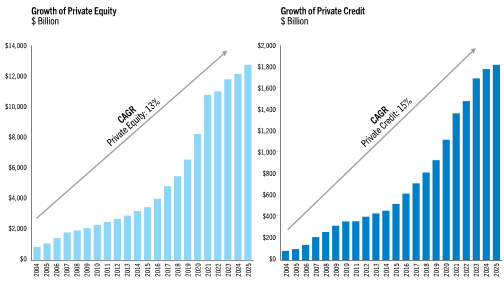
Not surprisingly, the rise of private credit has closely mirrored the growth of private equity (see Exhibit 4). Over the past two decades, global private equity assets under management have grown from $1.2 trillion to more than $12 trillion.
Less often acknowledged is how tightly private credit asset growth has tracked this expansion, climbing from about $80 billion in 2004 to over $1.7 trillion recently. The financing needs of private equity sponsors have created durable demand for private credit. As sponsors pursue more deals and larger transactions, they require lenders that can keep pace not only in dollars but in speed, confidentiality and structural flexibility. The parallel growth in private equity and private credit has been more than coincidental. It’s symbiotic.
Exhibit 4
The Symbiosis of Private Equity and Private Credit
Private Equity Capital Demand Grows, Non-Bank Lenders Respond
As commercial banks face higher regulatory burdens for holding leveraged middle market debt on their balance sheets, private equity sponsors seek ever greater amounts of debt capital from non-bank lenders to finance their deals.
Note: Certain statements herein constitute forward looking statements, which relate to future events, future performance or financial condition. Actual results could differ materially from those implied or expressed in forward looking statements for any reason, and future results could differ materially from historical performance. CAGR is defined as Compound Annual Growth Rate.
Source: Preqin. Data as of December 31, 2025.
If You Can’t Beat Them…
Banks at the Margin of Private Credit
Faced with persistent risk-based capital pressures and shrinking returns, banks have had to rethink their relationship with the private credit ecosystem. No longer comfortable storing credit risk on their balance sheets, banks have shifted to origination and syndication. That is, rather than holding loans, they package and sell them to a broad array of investors, which allows them to earn fees while minimizing risk-based capital charges.
And while banks have largely ceded the core business of private leveraged lending to non‑bank players, they continue to participate on the margins of the asset class. One example of this is the provision of credit facilities to private credit managers, including subscription lines, asset‑based leverage facilities or warehouse lines that help the managers scale their operations and smooth their capital deployment.
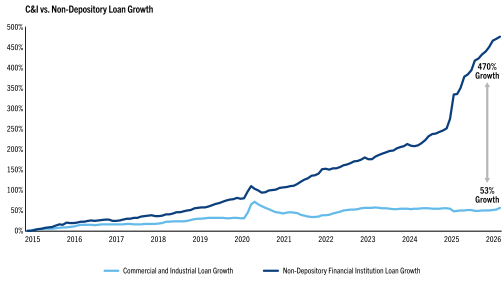
This activity has become increasingly profitable. Since 2015, non‑depository lending has grown far more rapidly than traditional C&I lending at banks, especially over the last few years (see Exhibit 5). While banks may no longer dominate sponsor finance, they remain important providers of structural support, extending liquidity to the private credit managers who do.
But for middle market borrowers, the center of gravity has shifted. The relationships, the talent pool and so much of the essential contours of what we know as sponsor finance have migrated to the non‑bank lending community—and there is very little likelihood of a reversal of that new status quo. While banks still play a role in the world of middle market lending, their involvement today is largely supportive and secondary to that of private non‑bank lenders.
Exhibit 5
Banks Seek Supporting Role on the Margins of Private Credit
Loans to Non-Bank Lenders on the Rise
With talent having migrated to non-bank lenders, banks are effectively out of the core private credit space; they seek other ways to participate in the direct lending ecosystem (e.g., in credit facilities to non-bank lenders).
Source: The Federal Reserve database of Assets and Liabilities of Commercial Banks in the United States from H.8 filings and Golub Capital internal analysis. Data as of March 31, 2026.
Disclaimer
In this document, the terms “Golub Capital” and “Firm” (and, in responses to questions that ask about the management company, general partner or variants thereof, the terms “Management Company” and “General Partner”) refer, collectively, to the activities and operations of Golub Capital LLC, GC Advisors LLC (“GC Advisors”), GC OPAL Advisors LLC (“GC OPAL Advisors”) and their respective affiliates or associated investment funds. A number of investment advisers, such as GC Investment Management LLC (“GC Investment Management”), Golub Capital Liquid Credit Advisors, LLC (Management Series) and OPAL BSL LLC (Management Series) (collectively, the “Relying Advisers”) are registered in reliance upon GC OPAL Advisors’ registration. The terms “Investment Manager” or the “Advisers” may refer to GC Advisors, GC OPAL Advisors (collectively the “Registered Advisers”) or any of the Relying Advisers. For additional information about the Registered Advisers and the Relying Advisers, please refer to each of the Registered Advisers’ Form ADV Part 1 and 2A on file with the SEC. Certain references to Golub Capital relating to its investment management business may include activities other than the activities of the Advisers or may include the activities of other Golub Capital affiliates in addition to the activities of the Advisers. This document may summarize certain terms of a potential investment for informational purposes only. In the case of conflict between this document and the organizational documents of any investment, the organizational documents shall govern.
Information is current as of the stated date and may change materially in the future. Golub Capital undertakes no duty to update any information herein. Golub Capital makes no representation or warranty, express or implied, as to the accuracy or completeness of the information herein.
Views expressed represent Golub Capital’s current internal viewpoints and are based on Golub Capital’s views of the current market environment, which is subject to change. Certain information contained in these materials discusses general market activity, industry or sector trends or other broad-based economic, market or political conditions and should not be construed as investment advice. There can be no assurance that any of the views or trends described herein will continue or will not reverse. Forecasts, estimates and certain information contained herein are based upon proprietary and other research and should not be interpreted as investment advice, as an offer or solicitation, nor as the purchase or sale of any financial instrument. Forecasts and estimates have certain inherent limitations, and unlike an actual performance record, do not reflect actual trading, liquidity constraints, fees, and/or other costs. In addition, references to future results should not be construed as an estimate or promise of results that a client portfolio may achieve. Past events and trends do not imply, predict or guarantee, and are not necessarily indicative of, future events or results. Private credit involves an investment in non-publicly traded securities which may be subject to illiquidity risk. Portfolios that invest in private credit may be leveraged and may engage in speculative investment practices that increase the risk of investment loss.
This presentation has been distributed for informational purposes only, and does not constitute investment advice or the offer to sell or a solicitation to buy any security. This presentation incorporates information provided by third-party sources that are believed to be reliable, but the information has not been verified independently by Golub Capital. Golub Capital makes no warranty or representation as to the accuracy or completeness of such third-party information. No part of this material may be reproduced in any form, or referred to in any other publication, without express written permission.
Past performance does not guarantee future results.
All information about the Firm contained in this document is presented as of May 2026, unless otherwise specified.
The Morningstar Indexes are the exclusive property of Morningstar, Inc. Morningstar, Inc., its affiliates and subsidiaries, its direct and indirect information providers and any other third party involved in, or related to, compiling, computing or creating any Morningstar Index (collectively, “Morningstar Parties”) do not guarantee the accuracy, completeness and/or timeliness of the Morningstar Indexes or any data included therein and shall have no liability for any errors, omissions, or interruptions therein. None of the Morningstar Parties make any representation or warranty, express or implied, as to the results to be obtained from the use of the Morningstar Indexes or any data included therein.
“Cliffwater,” “Cliffwater Direct Lending Index,” and “CDLI” are trademarks of Cliffwater LLC. The Cliffwater Direct Lending Indexes (the “Cliffwater Indexes”) and all information on the performance or characteristics thereof (“Cliffwater Index Data”) are owned exclusively by Cliffwater LLC, and are referenced herein under license. Neither Cliffwater nor any of its affiliates sponsor or endorse, or are affiliated with or otherwise connected to, Golub Capital, or any of its products or services. All Cliffwater Index Data is provided for informational purposes only, on an “as available” basis, without any warranty of any kind, whether express or implied. Cliffwater and its affiliates do not accept any liability whatsoever for any errors or omissions in the Cliffwater Indexes or Cliffwater Index Data, or arising from any use of the Cliffwater Indexes or Cliffwater Index Data, and no third party may rely on any Cliffwater Indexes or Cliffwater Index Data referenced in this report. No further distribution of Cliffwater Index Data is permitted without the express written consent of Cliffwater. Any reference to or use of the Cliffwater Index or Cliffwater Index Data is subject to the further notices and disclaimers set forth from time to time on Cliffwater’s website.

Dispersion & Persistence of Manager Performance in Direct Lending
Learn