

The Case for a Captive CLO Equity Fund
Insights from a Credit-First Manager
- White Paper
- Collateralized Loan Obligation (CLO) equity can be a compelling investment opportunity, offering a rare mix of front‑loaded cash distributions, upside potential and structural resilience.
- A captive fund structure can be an effective way to access this opportunity, providing structural control, programmatic deployment and diversified vintage exposure in a capital-efficient format.
- A credit-first manager is well positioned to support strong CLO equity outcomes: Disciplined underwriting builds credit strength, which translates into lower liability pricing and flexibility to capitalize on volatility across market environments.
CLO equity can be a compelling investment opportunity—but long‑term outcomes depend on how investors access the asset class and whom they partner with. A captive CLO equity fund can provide greater structural control, programmatic deployment and diversified vintage exposure in a capital‑efficient format. When paired with a credit‑first manager capable of delivering resilient performance across credit cycles, this structure can be a particularly effective way to unlock the full potential of CLO equity investing.
CLOs have evolved from a niche asset class into a major pillar of corporate financing. The U.S. broadly syndicated loan (BSL) CLO market now stands at nearly $1 trillion, and it holds approximately 68% of U.S. broadly syndicated corporate loans.1 The floating‑rate debt securities issued by CLOs have become staples in institutional portfolios for their consistent, attractive yields.
But CLOs offer more to investors than the asset‑backed debt exposure. For some investors, the equity tranche can be compelling—combining the potential for double‑digit private equity‑like returns with front‑loaded cash flows. Capturing that opportunity, however, requires careful attention to structure, incentives and manager selection.
The Benefits of Investing in CLO Equity
Before evaluating different investment structures, it is worth revisiting what makes CLO equity compelling in the first place.
Strong, Front‑Loaded Cash Flows
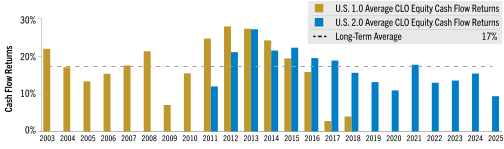
CLO equity has historically generated strong, double‑digit cash returns (see Exhibit 1). While private equity generally delivers returns following an extended J‑curve, CLO equity begins distributions within months of issuance, continuing quarterly for the life of the CLO.
Exhibit 1
CLO Equity Cash Flow Returns
Source: J.P. Morgan, Intex.
CLO 1.0 refers to the first generation of modern CLOs, issued in the mid- to late-1990s, and CLO 2.0 emerged in 2010 in response to the financial crisis, incorporating stronger credit protections and shortening the reinvestment period for loan interest and proceeds.
This return profile accelerates capital recovery, with as much as 18–20% of lifetime returns realized in the first year.2 The early‑return characteristic makes CLO equity particularly valuable in portfolio construction. It complements other back‑ended strategies and helps smooth portfolio‑level cash flows, all while preserving attractive upside potential, as we explain below.
Attractive Upside from Active Management
CLO equity’s attractive upside potential comes from active management on both sides of the balance sheet.
On the liability side, financing spreads are locked in at inception, providing stability for the life of the CLO. If financing conditions worsen, managers and equity holders enjoy below‑market financing costs. If financing conditions improve, managers have the option to refinance following a non‑call period, lowering liability costs and increasing the returns flowing to equity investors.
On the asset side, the loan portfolio is actively managed throughout the reinvestment period to mitigate loss and optimize value. Because CLOs are not subject to mark‑to‑market triggers, the structure avoids forced sales during volatility and allows managers to trade opportunistically. For example, when BSL prices decline, skilled managers purchase discounted loans to boost portfolio yields while capturing additional value as those loans accrete back to par.
These management levers are particularly valuable during periods of market stress, when volatility creates opportunities. For example, CLO equity vintages launched during dislocations, such as the global financial crisis (GFC) and COVID‑19, have delivered some of the highest internal rates of return (IRRs),3 outperforming private equity in those years.
Structural Resilience and Downside Mitigation
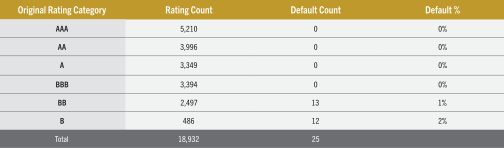
CLOs incorporate structural guardrails that help preserve value across market cycles and mitigate downside risk. The structure features both interest and principal coverage tests, ensuring timely interest payments to investors. Additionally, most CLOs must meet strict collateral quality and diversification requirements, including minimum weighted‑average rating thresholds, limits on lower‑rated exposures and concentration in individual borrowers or industries. Such constraints reduce volatility in collateral performance and support more predictable cash‑flow generation across cycles. Combined with the diversified base of first‑lien senior secured loans, these embedded protections have contributed to a long track record of resilient performance in CLO debt (see Exhibit 2).
Taken together, these attributes form a compelling case for CLO equity. Early and recurring distributions make it a great complement to other back‑ended strategies, while active management and embedded optionality—such as refinancing and opportunistic reinvestment—create pathways to enhanced returns. At the same time, diversification and structural protections help mitigate downside risk, supporting resilient performance even in volatile environments.
Exhibit 2
Credit Performance of CLOs Issued after the GFC
Sources: Guggenheim Investments; S&P data as of May 30, 2025.
The Case for a Captive CLO Equity Fund
For investors who see the merits of CLO equity, there are several ways to access the asset class. The most common approaches include:
- Captive CLO equity funds, which provide diversified, commingled exposure to a portfolio of CLO equity positions from a single manager
- Direct investments in individual CLO equity tranches, which offer targeted exposure to specific managers and vintages with greater control over portfolio construction
- Multi‑asset or opportunistic credit funds, which may include CLO equity as part of a broader portfolio of credit investments
All three approaches can deliver positive results for investors. However, we believe that captive equity funds offer a particularly compelling value proposition with several important benefits:
- Structural control: Majority equity positions provide meaningful influence over key structural decisions—deal terms, reinvestment parameters and call/reset provisions—that drive long‑term equity outcomes. A consolidated equity base allows managers to act on these levers when market conditions are favorable without relying on coordination among a fragmented group of investors.
- Programmatic deployment: By reliably anchoring the majority equity tranche in each new CLO, captive vehicles enable steady, disciplined deployment across market environments, including periods when conditions are attractive but standalone equity is difficult to source. It also streamlines the investor experience; fund terms are negotiated upfront, and capital is deployed over multiple deals without repeated diligence or approvals.
- Capital efficiency and diversification: Captive funds allow investors, particularly those with smaller allocations, to achieve broad diversification across deals and vintages while still meeting minimum commitment requirements. This creates more meaningful capital efficiency relative to assembling positions deal by deal or deploying their entire allocation into a single CLO.
- Alignment of interests: Some captive structures further strengthen the alignment between the manager and investors by having the management company invest a meaningful amount of its own capital alongside external commitments. This “skin in the game” creates shared incentives and reinforces a disciplined approach to risk and return.
Importance of Partnering with a Credit-First Manager
For investors seeking CLO equity exposure, a captive fund offers an efficient path with distinct advantages. But this approach makes manager selection even more critical.
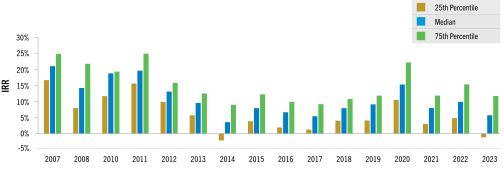
In practice, performance varies meaningfully between top‑ and bottom‑quartile managers, underscoring the importance of manager skill in generating alpha (see Exhibit 3).
Exhibit 3
U.S. CLO Vintage IRR Dispersion by Quartile
Source: BofA Global Research, Intex.
Note: 2009 is excluded due to minimal CLO issuance following the GFC.
As a market‑leading CLO issuer, we believe “credit‑first” managers with the following attributes are best positioned to drive strong equity performance:
- Low liability costs: Managers recognized for their credit prowess command lower liability costs, which enables them to produce higher equity returns per unit of risk. Their long track records of disciplined underwriting, low defaults and consistent compliance with coverage tests attract stronger investor demand for their debt tranches. This demand translates into lower all‑in funding costs at issuance and greater flexibility to refinance liabilities when market conditions improve. Because CLO equity returns are highly sensitive to liability pricing, even modest reductions in financing spreads can meaningfully increase residual cash flows to equity.
- Long‑term orientation: While CLO structures protect against forced selling, managers still face critical decisions about which credits to hold, trim or exit. Credit‑first managers approach these decisions with discipline, positioning the portfolio for resilience from the outset and maintaining a steady, long‑term view through market cycles. Their emphasis on minimizing credit losses is especially important in highly levered structures where even modest impairment can materially affect equity outcomes.
- Flexibility through credit strength: Managers who maintain high‑quality portfolios are better able to withstand market cycles. Strong credit fundamentals help keep coverage tests intact during periods of stress, which in turn preserves the flexibility to capitalize on wider spreads and discounted loans. This flexibility enables them to remain on the offense during dislocations, precisely when reinvestment optionality can meaningfully enhance long‑term equity returns.
- Consistent capital markets access: Established CLO managers with consistent credit performance benefit from a positive feedback loop in capital markets. They attract deeper investor demand, which leads to more frequent and tighter secondary trading of their CLO tranches. This liquidity, combined with a reliable equity and debt investor base, allows them to issue new CLOs even during periods of volatility, often at lower liability costs and with higher net spreads to equity. As a result, they are better positioned to create CLOs in the very environments that historically produce the strongest equity performance.
- Sponsor‑focused portfolio: Strong relationships with private equity sponsors—built through the repeat financing activity of an established private credit platform—provide early insight into borrower developments, preferential access to new issues and first‑call status when sponsors seek capital solutions during periods of liquidity stress. This connectivity translates directly into differentiated collateral sourcing and reinvestment opportunities. Importantly, sponsor‑backed loans have historically delivered lower default and loss rates than non‑sponsored borrowers, contributing to a higher baseline credit quality in the underlying collateral.4
Key Takeaways for Investors
CLO equity offers a compelling mix of cash income, potential upside and structural resilience—a rare combination in today’s investing landscape. For investors seeking exposure, captive funds provide distinct advantages, including structural control, programmatic deployment, diversification and alignment of interests. With captive funds tied to a single platform, however, the choice of manager is critical.
Credit‑first managers bring capabilities that drive strong equity outcomes: Disciplined underwriting builds credit strength, which in turn allows them to secure low liability pricing and capitalize on volatility across market environments. As investors look beyond traditional investment strategies, CLO equity can be a valuable building block in long‑term portfolio construction when entrusted to experienced hands.
Appendix: Understanding the CLO Structure
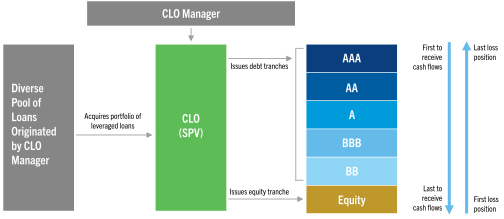
At its core, a CLO is a diversified pool of senior secured, floating‑rate corporate loans—typically first lien loans to non‑investment grade borrowers. These loans are packaged into a special purpose vehicle, which issues multiple debt tranches and a subordinated equity tranche, all supported by the cash flows of the underlying loan portfolio (see Exhibit 4). Each debt tranche carries its own credit rating, coupon and level of structural protection, reflecting its seniority within the capital structure and its assessed creditworthiness.
Cash flows generated by the underlying loans are distributed through a quarterly waterfall that pays tranches in order of seniority. Senior debt tranches receive interest and principal first, followed by the mezzanine tranches, with the equity tranche receiving all remaining cash flow. Equity holders, therefore, capture the excess spread—the difference between the portfolio yield and payments owed to debt holders.
Although equity sits at the bottom of the capital structure and absorbs any losses first, it also has exclusive access to substantial residual cash flows generated by well‑constructed CLOs and stands to benefit most from upside under favorable conditions.
Exhibit 4
CLO Overview
Source: Golub Capital.
1. Sources: Bank of America Global Research, Intex, Leveraged Commentary and Data (LCD), as of January 31, 2025.
2. Barings, CLO Equity: 101. Data as of July 2024.
3. Invesco, CLO Equity: Not Your Average Asset Class. Data as of February 2025.
4. Per JPM U.S. High Yield and Leveraged Loan Strategy data as of January 2026. Since 2010, sponsor‑led loans have exhibited an average annual default rate of 1.64% vs. 2.13% for non‑sponsor loans and an average default loss of 71 bps versus 96 bps, respectively.
Disclaimer
In this document, the terms “Golub Capital” and “Firm” (and, in responses to questions that ask about the management company, general partner or variants thereof, the terms “Management Company” and “General Partner”) refer, collectively, to the activities and operations of Golub Capital LLC, GC Advisors LLC (“GC Advisors”), GC OPAL Advisors LLC (“GC OPAL Advisors”) and their respective affiliates or associated investment funds. A number of investment advisers, such as GC Investment Management LLC (“GC Investment Management”), Golub Capital Liquid Credit Advisors, LLC (Management Series) and OPAL BSL LLC (Management Series) (collectively, the “Relying Advisers”) are registered in reliance upon GC OPAL Advisors’ registration. The terms “Investment Manager” or the “Advisers” may refer to GC Advisors, GC OPAL Advisors (collectively the “Registered Advisers”) or any of the Relying Advisers. For additional information about the Registered Advisers and the Relying Advisers, please refer to each of the Registered Advisers’ Form ADV Part 1 and 2A on file with the SEC. Certain references to Golub Capital relating to its investment management business may include activities other than the activities of the Advisers or may include the activities of other Golub Capital affiliates in addition to the activities of the Advisers. This document may summarize certain terms of a potential investment for informational purposes only. In the case of conflict between this document and the organizational documents of any investment, the organizational documents shall govern.
Information is current as of the stated date and may change materially in the future. Golub Capital undertakes no duty to update any information herein. Golub Capital makes no representation or warranty, express or implied, as to the accuracy or completeness of the information herein.
Views expressed represent Golub Capital’s current internal viewpoints and are based on Golub Capital’s views of the current market environment, which is subject to change. Certain information contained in these materials discusses general market activity, industry or sector trends or other broad-based economic, market or political conditions and should not be construed as investment advice. There can be no assurance that any of the views or trends described herein will continue or will not reverse. Forecasts, estimates and certain information contained herein are based upon proprietary and other research and should not be interpreted as investment advice, as an offer or solicitation, nor as the purchase or sale of any financial instrument. Forecasts and estimates have certain inherent limitations, and unlike an actual performance record, do not reflect actual trading, liquidity constraints, fees, and/or other costs. In addition, references to future results should not be construed as an estimate or promise of results that a client portfolio may achieve. Past events and trends do not imply, predict or guarantee, and are not necessarily indicative of, future events or results. Private credit involves an investment in non-publicly traded securities which may be subject to illiquidity risk. Portfolios that invest in private credit may be leveraged and may engage in speculative investment practices that increase the risk of investment loss.
This presentation has been distributed for informational purposes only, and does not constitute investment advice or the offer to sell or a solicitation to buy any security. This presentation incorporates information provided by third-party sources that are believed to be reliable, but the information has not been verified independently by Golub Capital. Golub Capital makes no warranty or representation as to the accuracy or completeness of such third-party information. No part of this material may be reproduced in any form, or referred to in any other publication, without express written permission.
Past performance does not guarantee future results.
All information about the Firm contained in this document is presented as of April 2026, unless otherwise specified.


Crowded Market in Private Credit? Enter the Large, Public Alternative Managers
Learn