

Disillusioned by anemic projected public equity returns, investors may be inclined to seek some respite from rising valuations and high volatility common to most stock indexes. Replacing public equities with private direct lending may enable investors to achieve performance on par with or better than future stock market returns and with far less risk.
Annualized Realized Returns, Net of Fees, Since Q4 2004

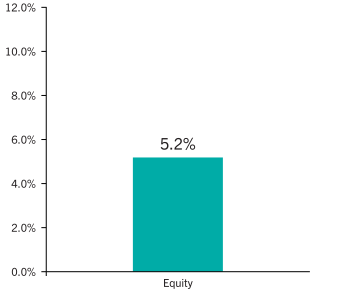
Note: Modeling assumptions by Altar Rock LLC, initial market conditions as of September 1, 2024. Equities referenced by S&P 500. Equity total returns are reduced by estimated fees = 42 bps as per asset-weighted average fee in Investment Company Institute Fact 2024.
Forward-looking simulations are produced by proprietary research. While these are developed with care, there can be no guarantee that they depict the full range of potential future returns or of matching the true, unknown probabilities of outcomes.
But it’s not just macro factors driving potentially less attractive equity returns going forward; it’s also basic valuation and equity market dynamics. The S&P 500 once seemed to offer broad diversification for equity investors, capturing approximately 80% of the total market capitalization of U.S. public companies.2
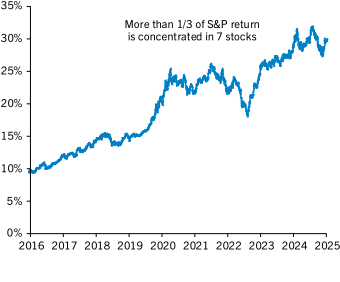
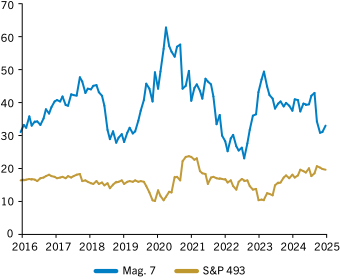
However, for investors in S&P 500 index funds, about one-third of their money has been subject to the vicissitudes of just seven stocks over the last several years. Meanwhile, the value of these “Magnificent 7” stocks has risen exponentially, and they are anything but bargains— especially when compared to the other 493 firms in the index (Exhibit 2).3
The trend toward greater concentration risk and higher volatility in equities is self-perpetuating. Over half of the money invested in the U.S. stock market sits in passive index funds.4 These funds are on autopilot, blindly allocating larger amounts of capital to a diminishing number of large-cap stocks with the strongest price increases. How can investors escape from this prison house of indexation and concentration risk without abandoning the key engine for portfolio growth that equities historically provided?
S&P Returns Concentrated in 7 Stocks
The direct lending asset class may present some attractions as a replacement for traditional public equities. Judging simply from a return perspective, they have been close peers historically. And while projected equity returns may take a severe haircut in the next two decades, direct lending is forecasted by some to do as well or even better in the future than the last 20 years—and better than equities themselves (Exhibit 3).5
Moreover, there are strong ties between public equity and private credit. The typical borrower company in a direct lending portfolio bears a close resemblance to certain publicly traded firms. As an example, an equity index representing small-cap companies would constitute a publicly traded near-equivalent to the type of private borrowers funded by direct lending managers. In fact, companies in the Russell 2000 index and borrowers in the Cliffwater Direct Lending Index (CDLI) reveal a number of striking, sibling-like parallels, where constituent companies tend to have similar EBITDA and leverage (Exhibit 4).6 They also look remarkably alike in terms of their sector weightings.7
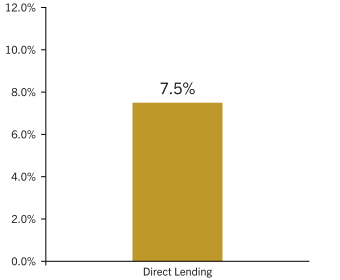
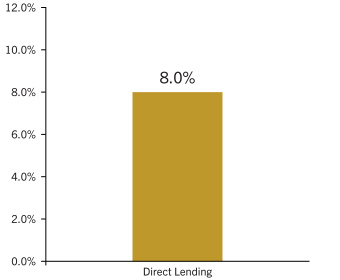
Note: Modeling assumptions by Altar Rock LLC, initial market conditions as of September 1, 2024. Direct lending model is based on CDLI. These illustrations should not be viewed as representative of other asset classes, mixes thereof or actual investment portfolios that may employ strategies not depicted here. Net DL income and total return are reduced by estimated fund-level fees and expenses totaling 193 bps, as per CDLI Index Research.
Forward-looking simulations are produced by proprietary research. While these are developed with care, there can be no guarantee that they depict the full range of potential future returns or of matching the true, unknown probabilities of outcomes.
Sector Exposure Comparison

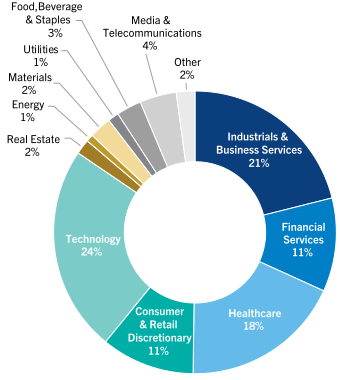
Of course, the fundamental difference is that these Russell 2000 companies are public–exchange traded stocks, while sponsor-backed middle market borrowers are private companies—typically select, high-growth firms identified as especially attractive acquisition targets by private equity general partners. As a result, private equity as an asset class, the portfolios of which consist mostly of these types of “small-cap” companies (but as private firms), has a correlation with private direct lending as high as 0.80.8
The other key distinction is that direct lending strategies depend on very different—and less risky—factors to drive their returns: contractually-obligated payment of interest and repayment of principal. As a result, while the returns of small-cap equity and direct lending may be similar in magnitude, their risks are most assuredly not. Direct lending, positioned at the top of the capital structure, tends to be a defensive asset characterized by highly consistent interest income. In contrast, equity ownership, attaching at the risky bottom of the capital stack, depends on uncertain equity multiples and capital appreciation return drivers.
Finally, several investment vehicles for accessing private direct lending (including semi-liquid non-traded Business Development Companies (BDCs) or private closed-end “drawdown” funds) do not participate in or reflect the very high intraday market volatility of the public equity market. Investing in these volatility-dampening structures may give investors additional comfort when considering a potential “swap” from public equities to private credit.
The reality is many investors intuitively think of direct lending as a replacement not for equities but for some portion of their bond allocation—they are debt investments after all. But recall that credit (and especially sub-investment-grade credit) shares some investment DNA with equity, both public and private. Indeed, the relationship between public equity and direct lending (~0.75) is in the same neighborhood as public equity’s correlation to private equity (0.85).9 Some may conclude that it’s as intuitive to replace a portfolio’s public equity allocation with private equity as it is to replace (or complement) it with direct lending.
We start with a typical 60% equity and 40% bond portfolio, looking back at its return, risk and income profiles over the last 20 years, net of fund fees. We then incorporate a direct lending allocation of 20%, sourcing the majority of the allocation (65% or 13 percentage points) from the original public equity exposure. We then re-examine the historic return, risk and income profile of this blended portfolio (Exhibit 5).
Chief among the benefits of the new allocation may be the ability to achieve a lower-risk total portfolio— taking some of the edge off public market equity volatility without compromising on returns. Sourcing the greater part of the direct lending allocation from a client’s more volatile equity sleeve enables clients to achieve a 17% reduction in portfolio volatility (from 9.9% to 8.2%). Total returns remain consistent at 7.4%.
More remarkable in the new allocation (especially for clients who are seeking consistent cash flows to support retirement spending) is the dramatic increase in portfolio yield. Net of fee income in the portfolio over the 20-year history of the analysis increases from 2.3% to 3.6% annually—an improvement of almost 60%.
The limit of this analysis is that it is backward-looking by nature. With future returns from public equities forecasted to be about half their previous magnitude, the appeal of direct lending as an equity replacement may only grow over time.

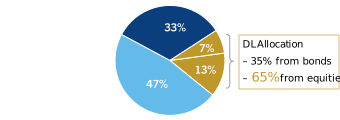
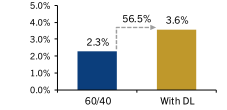
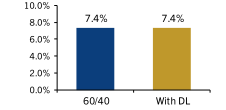
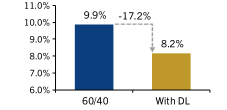
Note: Equities and bond returns are represented by the S&P 500 and Bloomberg US Agg., respectively. Direct lendings are represented by the unlevered CDLI. Net NAV DL income and total return are reduced by estimated fund-level fees and expenses totaling 193 bps. Stock and bond income/total return are reduced by estimated fees = 42 bps and 37 bps, respectively, as per average asset-weighted fees in each asset category based on Investment Company Institute 2024 Factbook. Time period analyzed Q4 2004 (since CDLI inception) to Q2 2024; returns and volatilities presented on annualized basis. Suggested allocations will vary depending on constraints applied; recommended sourcing is derived from many factors, including relative correlations, volatilities, returns and income for each asset alone and in combination with the other two.
1. The allocation analytics and forward modeling of the asset classes represented here were conducted for Golub Capital by Altar Rock LLC, a registered investment advisor (RIA) in the United States with personnel who claim a long history and deep expertise in the area of capital markets forecasting.
2. S&P 500 Index, Bloomberg, Golub Capital Analysis.
3. Over 2024, 100% of the S&P 500’s returns came from just 10 stocks. For the last several years, over a third of the total returns were driven not by 500, but 4 (Facebook, Amazon, Nvidia, Google (“FANG”)), 5 (FANG and Apple) and then 7 (“Magnificent 7”) individual stocks, with average price/equity ratios in the 40s, compared to the other 493 stocks in the S&P 500, whose P/E ratio averaged just under 20 over the last 5 years.
4. Source: von Motke, Felix, and Slok, Torsten, Assessing the Impact of Passive Investing over Time: Higher Volatility, Reduced Liquidity, and Increased Concentration, Apollo. Anadu, Kenechukwu and Kruttli, Mathias S. and McCabe, Patrick E. and Osambela, Emilio and Shin, Chaehee, The Shift From Active to Passive Investing: Potential Risks to Financial Stability? (September 17, 2019).
5. The forward modeling of the asset classes represented here was conducted for Golub Capital by Altar Rock LLC, an RIA in the United States with personnel who claim a long history and deep expertise in the area of capital markets forecasting. The projections are in line with other forecasts from leading investment consultants, including Cliffwater, among others.
6. According to Stephen Nesbitt in Private Debt (2023), the average EBITDAs of Russell 2000 and CDLI companies are reasonably close. He calculates average EBITDA of Russell 200 companies at ~$75M, roughly the midpoint of the $10M to $125M EBITDA range that defines the core middle market. Average EBITDA for the CDLI was calculated at $62M by Nesbitt.
7. The Russell 2000 Index of middle market and smaller company stocks have industry weightings similar to middle market loans. Differences appear in a few sectors, including financials and information technology. These differences are explained by the unlikely presence of banks among middle market borrowers and a higher percentage of information technology borrowers in the CDLI. Source: FTSE Russell; Cliffwater; Bloomberg, as of December 31, 2024. “Cliffwater,” “Cliffwater Direct Lending Index,” and “CDLI” are trademarks of Cliffwater LLC. The Cliffwater Direct Lending Indexes (the “Cliffwater Indexes”) and all information on the performance or characteristics thereof (“Cliffwater Index Data”) are owned exclusively by Cliffwater LLC and are referenced herein under license. Neither Cliffwater nor any of its affiliates sponsor or endorse, or are affiliated with or otherwise connected to, Golub Capital or any of its products or services. All Cliffwater Index Data is provided for informational purposes only, on an “as available” basis, without any warranty of any kind, whether express or implied. Cliffwater and its affiliates do not accept any liability whatsoever for any errors or omissions in the Cliffwater Indexes or Cliffwater Index Data or those arising from any use of the Cliffwater Indexes or Cliffwater Index Data, and no third party may rely on any Cliffwater Indexes or Cliffwater Index Data referenced in this report. No further distribution of Cliffwater Index Data is permitted without the express written consent of Cliffwater. Any reference to or use of the Cliffwater Index or Cliffwater Index Data is subject to the further notices and disclaimers set forth from time to time on Cliffwater’s website at https://www.cliffwaterdirectlendingindex.com/disclosures.
8. Cliffwater 2025 Asset Allocation Report.
9. Correlations are based on quarterly returns from September 30, 2004, through December 31, 2024. The indices used in this analysis are as follows. Direct lending is represented by the CDLI; public equity is represented by the Russell 2000 Index; and private equity is represented by Cambridge U.S. Buyout Index is based on horizon returns data compiled from U.S. institutional-quality buyout funds, including fully liquidated partnerships, formed between 1986 and 2017. The Russell 2000 Index is a small-cap U.S. stock market index that makes up the smallest 2,000 stocks in the Russell Index; high yield is represented by the ICE BofA US High Yield Index. The ICE BofA US High Yield Index tracks the performance of dollar-denominated, below-investment-grade corporate debt publicly issued in the U.S. domestic market; leveraged loans are presented by the Morningstar LSTA US Leveraged Loan Index. The Morningstar LSTA US Leveraged Loan Index is a market value–weighted index designed to measure the performance of the U.S. broadly syndicated leveraged loan market. The Morningstar LSTA US Leveraged Loan Index typically encompasses 90–95% of the entire broadly syndicated leveraged loan market. Source: Bloomberg, Cliffwater.
In this document, the terms “Golub Capital” and “Firm” (and, in responses to questions that ask about the management company, general partner or variants thereof, the terms “Management Company” and “General Partner”) refer, collectively, to the activities and operations of Golub Capital LLC, GC Advisors LLC (“GC Advisors”), GC OPAL Advisors LLC (“GC OPAL Advisors”) and their respective affiliates or associated investment funds. A number of investment advisers, such as GC Investment Management LLC (“GC Investment Management”), Golub Capital Liquid Credit Advisors, LLC (Management Series) and OPAL BSL LLC (Management Series) (collectively, the “Relying Advisers”) are registered in reliance upon GC OPAL Advisors’ registration. The terms “Investment Manager” or the “Advisers” may refer to GC Advisors, GC OPAL Advisors (collectively the “Registered Advisers”) or any of the Relying Advisers. For additional information about the Registered Advisers and the Relying Advisers, please refer to each of the Registered Advisers’ Form ADV Part 1 and 2A on file with the SEC. Certain references to Golub Capital relating to its investment management business may include activities other than the activities of the Advisers or may include the activities of other Golub Capital affiliates in addition to the activities of the Advisers. This document may summarize certain terms of a potential investment for informational purposes only. In the case of conflict between this document and the organizational documents of any investment, the organizational documents shall govern.
Information is current as of the stated date and may change materially in the future. Golub Capital undertakes no duty to update any information herein. Golub Capital makes no representation or warranty, express or implied, as to the accuracy or completeness of the information herein.
Views expressed represent Golub Capital’s current internal viewpoints and are based on Golub Capital’s views of the current market environment, which is subject to change. Certain information contained in these materials discusses general market activity, industry or sector trends or other broad-based economic, market or political conditions and should not be construed as investment advice. There can be no assurance that any of the views or trends described herein will continue or will not change or reverse. Forecasts, estimates and certain information contained herein are based upon proprietary and other research and should not be interpreted as investment advice, as an offer or solicitation, nor as the purchase or sale of any financial instrument. Forecasts and estimates have certain inherent limitations, and unlike an actual performance record, do not reflect actual trading, liquidity constraints, fees, and/or other costs. In addition, references to future results should not be construed as an estimate or promise of results that a client portfolio may achieve. Past events and trends do not imply, predict or guarantee, and are not necessarily indicative of, future events or results. Private credit involves an investment in non-publically traded securities which may be subject to illiquidity risk. Portfolios that invest in private credit may be leveraged and may engage in speculative investment practices that increase the risk of investment loss.
This presentation has been distributed for informational purposes only, and does not constitute investment advice or the offer to sell or a solicitation to buy any security. This presentation incorporates information provided by third-party sources that are believed to be reliable, but the information has not been verified independently by Golub Capital. Golub Capital makes no warranty or representation as to the accuracy or completeness of such third-party information. No part of this material may be reproduced in any form, or referred to in any other publication, without express written permission.
Past performance does not guarantee future results.
All information about the Firm contained in this document is presented as of March 31, 2025, unless otherwise specified.
“Cliffwater,” “Cliffwater Direct Lending Index,” and “CDLI” are trademarks of Cliffwater LLC. The Cliffwater Direct Lending Indexes (the “Cliffwater Indexes”) and all information on the performance or characteristics thereof (“Cliffwater Index Data”) are owned exclusively by Cliffwater LLC, and are referenced herein under license. Neither Cliffwater nor any of its affiliates sponsor or endorse, or are affiliated with or otherwise connected to, Golub Capital, or any of its products or services. All Cliffwater Index Data is provided for informational purposes only, on an “as available” basis, without any warranty of any kind, whether express or implied. Cliffwater and its affiliates do not accept any liability whatsoever for any errors or omissions in the Cliffwater Indexes or Cliffwater Index Data, or arising from any use of the Cliffwater Indexes or Cliffwater Index Data, and no third party may rely on any Cliffwater Indexes or Cliffwater Index Data referenced in this report. No further distribution of Cliffwater Index Data is permitted without the express written consent of Cliffwater. Any reference to or use of the Cliffwater Index or Cliffwater Index Data is subject to the further notices and disclaimers set forth from time to time on Cliffwater’s website at https://www.cliffwaterdirectlendingindex.com/disclosures. This document is intended for institutional and other qualifying investors only. Do not copy or distribute.
"*" indicates required fields
Get Real [Returns] with Direct Lending
Learn