

Inflation has become a non-transitory concern for investors. Several real asset classes such as commodities and gold are thought to provide “inflation insurance” for a portfolio, but they come with high volatility and rarely any income return. The utility of income-rich direct lending exposure as a strategic defense against rising prices may be worth considering.
We tend to think of investments in a nominal or pre-inflationary context, but we live, and spend, in the “real” world. That’s one reason the damage inflation causes to an investment portfolio can be so insidious: It’s hard to identify contemporaneously but no less debilitating to both purchasing power and long-term wealth.
This is causing some angst among investors. Consumer inflation expectations from the Michigan Survey have been rising to levels not seen in years. Market-tied projections of future inflation, such as 5-Year Breakevens,¹ are more measured but still suggest an inflation rate about 70% higher than what we grew accustomed to over the previous five-year period (Exhibit 1).
While no one can know for sure, it may be that inflation (and by extension interest rates) will oscillate in a “higher for longer” range for some time ahead. Such concerns may add to investor interest in direct lending, which, due to its floating rate nature, tends to benefit from rising rates. But it’s the inflation-mitigating characteristics of the asset class that have arguably gone under-acknowledged by allocators.
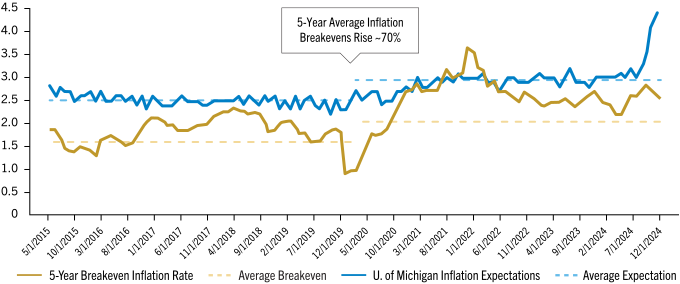
Source: University of Michigan Consumer Survey of Inflation Expectations, as of February 2025. Federal Reserve Bank of St. Louis 5-Year Breakeven Inflation Rate as of February 2025.
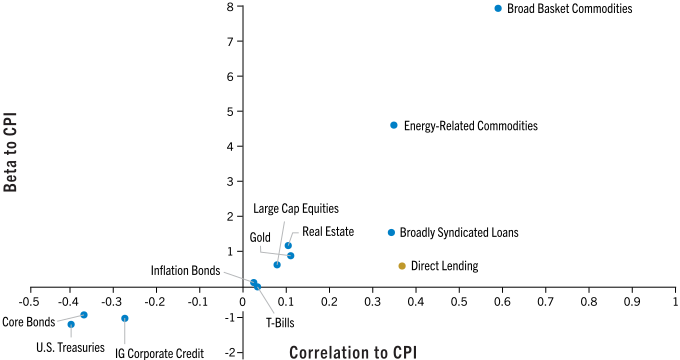
When it comes to incorporating long-term inflation resilience in portfolios, investors typically look to some combination of real assets, including broad basket commodities (such as the Goldman Sachs Commodity Index, or GSCI) or individual real assets, including energy, real estate, or gold. Yet, senior loans as an asset class (both public broadly syndicated loans and private middle market loans) may be a valid “real-return” candidate worth including in an investor’s preferred subset of inflation-fighting assets.
Looking over the last 20 years, senior loans have a quarterly correlation to headline CPI of about .40. That’s surely lower than broad commodities (~.60), but on par with the energy sector and higher than “inflation bonds” (or Treasury Inflation-Protected Securities), or T-bills—assets well known for their inflation-resistant characteristics (Exhibit 2).
In addition to an asset’s correlation to inflation, investors often consider the magnitude of its response to price increases (its inflation “beta”). Again, the assets that benefit most from rising inflation tend to be those more directly impacted by raw price increases, such as commodities broadly, oil and gas, and real estate. While senior loans possess an inflation beta that is lower than most commodity-oriented exposures, it is higher than most other financial assets. This is due, in part, to the robust income component of direct lending returns, which rises along with interest rates and can be particularly effective in offsetting higher costs.
These results may not surprise, given the floating rate nature of both public syndicated loans and directly originated loans in private credit. We know intuitively that rates and inflation are a natural pair—they follow each other over time, with rising interest rates typically a “lagged” central bank response to rising inflation.
Over the last 50 years, federal fund rates have consistently ascended on the back of rising inflation, with a typical delay of several quarters or longer (Exhibit 3). Floating rate loans would tend to automatically climb in tandem.
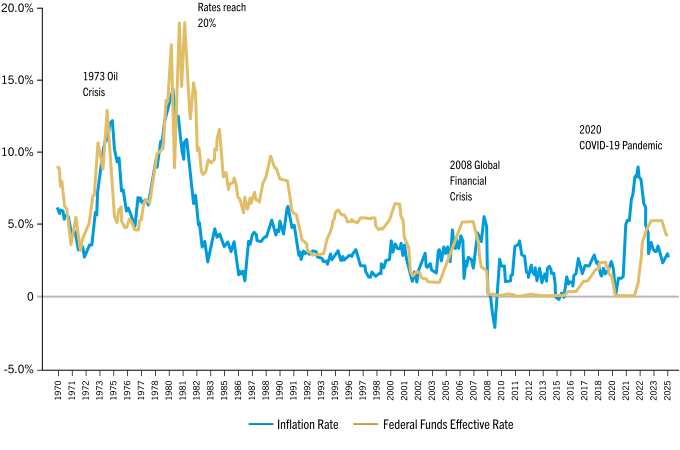
Source: Federal Reserve Bank of St. Louis via FRED®: Fed Funds Rate and Headline or Urban CPI from Jan 1970 to Jan 2025.
The coincidence in time of rising inflation and rising rates can be highly damaging to most traditional bond portfolios. The average duration of core bonds (approximately six years) renders them an easy target for rising rates, which have a negative impact on bond prices. At the same time, the “fixed” nature of their coupons renders their income component particularly susceptible to the erosion that rising inflation can cause. The historic underperformance that core bonds experienced in 2022, down 13% for the year, was due in large part to this double whammy.
In contradistinction, direct lending tends to benefit from both rising rates and inflation. As a floating rate asset, both public market loans and direct lending have very low duration or interest rate risk (about a quarter year). As a result, the healthy spread or income component associated with direct lending tends to rise in lockstep with rising rates (with a few months’ delay). That higher gross yield should reduce the asset’s vulnerability to rising inflation and help preserve a client’s spending power in an environment of higher costs.
All of this contrasts with more traditional fixed income sectors, from investment grade corporates to core bonds to high yield and munis, which have higher duration and lower income yields—and hence much greater sensitivity to rising rates and vulnerability to inflation (Exhibit 4).
Yield vs. Duration: Direct Lending vs. Traditional Fixed Income
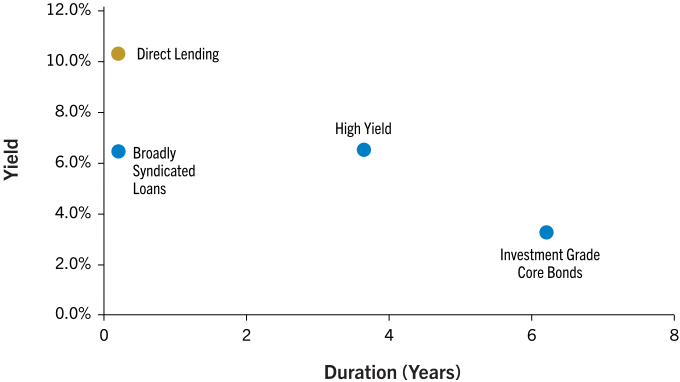
Source: Morningstar. CDLI Q2 2015–Q1 2025. Data as of April 30, 2025. Duration for direct lending and broadly syndicated loans are floating rate and are for illustrative purposes only.
Note: Past performance does not guarantee future results. You cannot invest directly in an index, and index returns do not take into account trading commissions and costs. The volatility of indices may be materially different from the performance of Golub Capital Funds. Index returns reflect all items of income, gain and loss and the reinvestment of dividends and other income.
These are all important characteristics of the asset class on its own, but direct lending’s inflation-fighting value in a portfolio context is worth exploring. Any benefits would likely come over time in the form of a timely yield ballast to counter the rate sensitivity and income erosion suffered by the fixed coupons of a traditional core bond portfolio.
We don’t possess long-term periods of high or rising inflation that coincide with the return history of direct lending as a distinct asset class. But, as a proxy, we could look at the admittedly short period from June 2020 through September 2022, when inflation climbed to north of 9%, and federal fund rates ascended from near zero to over 5%.
During this two-year window, a typical 60% equity and 40% bond portfolio faced obvious headwinds. Equities zig-zagged, mostly in a negative direction. Meanwhile, traditional core bonds experienced historically bad results: Quarterly net returns for the Bloomberg US Aggregate were underwater for most of the period, particularly as rates began to rise in 2022 (when returns for bonds were -6% for the first quarter, and -4.8% for both the second and third quarters) (Exhibit 5).
Meanwhile, income-oriented direct lending held steady, navigating this period of combined inflation and rising rates with fairly uniform net-of-fee returns. In a portfolio context, a 20% allocation to direct lending would have helped buoy the portfolio’s income return by over 50% relative to a traditional 60/40 portfolio over this period.
Quarterly Net-of-Fee Returns
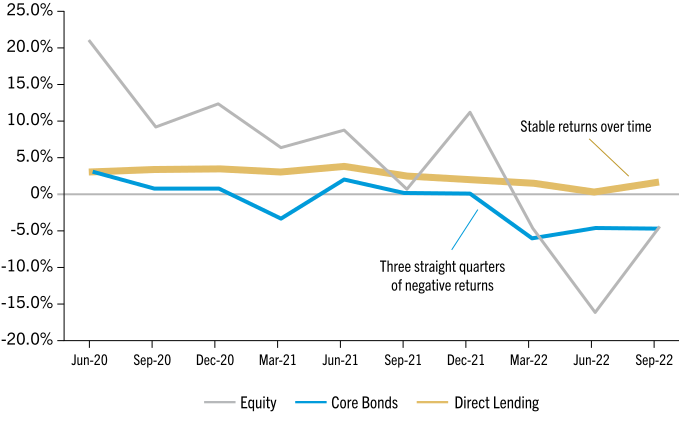
Equities and bond returns are represented by the S&P 500 and Bloomberg US Agg., respectively. “Direct Lending” is represented by the unlevered CDLI index. Net NAV DL income and total return are reduced by estimated fund-level fees and expenses totaling 193 bps. Stock and bond income/total return are reduced by estimated fees: 42 bps and 37 bps, respectively, based on Investment Company Institute 2024 Factbook, using asset-weighted average fee levels for each asset class. The time period analyzed was June 2020 through September 2022, with returns and volatilities presented on annualized basis.
Humility is important in this analysis: There is no way to know the direction of future inflation or rates. And in some scenarios (such as stagflation), it may well be that the two (rates and inflation) move in opposite paths for some time.
Moreover, away from such macro-economic topics, there are other less visible and more complicated inflationary variables in a direct lending portfolio that are difficult to pin down. As an example, for many middle market firms, the natural consequence of rising rates is falling cashflows, which could weigh on borrower EBITDA. And any individual company’s exposure to, and ability to “pass through,” inflationary input costs will vary; for some, rising prices could eat into precious liquidity set aside for loan interest payments, leading to potential credit losses.
No asset class is without some vulnerability to inflation, but investors need some defense. When allocators build inflation insurance into their portfolio, they typically acknowledge that it comes at some cost or premium. The high and consistent income return of direct lending may help mitigate that cost for some allocators. At a broad, asset class level, the inflation-fighting benefits of direct lending may deserve more “credit” than they’ve received and help underscore the versatility of this nearly all-weather asset.
1. A measure of expected inflation based on the difference in yield between a standard Treasury security (nominal) and an inflation-protected Treasury security (real).
In this document, the terms “Golub Capital” and “Firm” (and, in responses to questions that ask about the management company, general partner or variants thereof, the terms “Management Company” and “General Partner”) refer, collectively, to the activities and operations of Golub Capital LLC, GC Advisors LLC (“GC Advisors”), GC OPAL Advisors LLC (“GC OPAL Advisors”) and their respective affiliates or associated investment funds. A number of investment advisers, such as GC Investment Management LLC (“GC Investment Management”), Golub Capital Liquid Credit Advisors, LLC (Management Series) and OPAL BSL LLC (Management Series) (collectively, the “Relying Advisers”) are registered in reliance upon GC OPAL Advisors’ registration. The terms “Investment Manager” or the “Advisers” may refer to GC Advisors, GC OPAL Advisors (collectively the “Registered Advisers”) or any of the Relying Advisers. For additional information about the Registered Advisers and the Relying Advisers, please refer to each of the Registered Advisers’ Form ADV Part 1 and 2A on file with the SEC. Certain references to Golub Capital relating to its investment management business may include activities other than the activities of the Advisers or may include the activities of other Golub Capital affiliates in addition to the activities of the Advisers. This document may summarize certain terms of a potential investment for informational purposes only. In the case of conflict between this document and the organizational documents of any investment, the organizational documents shall govern.
Information is current as of the stated date and may change materially in the future. Golub Capital undertakes no duty to update any information herein. Golub Capital makes no representation or warranty, express or implied, as to the accuracy or completeness of the information herein.
Views expressed represent Golub Capital’s current internal viewpoints and are based on Golub Capital’s views of the current market environment, which is subject to change. Certain information contained in these materials discusses general market activity, industry or sector trends or other broad-based economic, market or political conditions and should not be construed as investment advice. There can be no assurance that any of the views or trends described herein will continue or will not change or reverse. Forecasts, estimates and certain information contained herein are based upon proprietary and other research and should not be interpreted as investment advice, as an offer or solicitation, nor as the purchase or sale of any financial instrument. Forecasts and estimates have certain inherent limitations, and unlike an actual performance record, do not reflect actual trading, liquidity constraints, fees, and/or other costs. In addition, references to future results should not be construed as an estimate or promise of results that a client portfolio may achieve. Past events and trends do not imply, predict or guarantee, and are not necessarily indicative of, future events or results. Private credit involves an investment in non-publically traded securities which may be subject to illiquidity risk. Portfolios that invest in private credit may be leveraged and may engage in speculative investment practices that increase the risk of investment loss.
This presentation has been distributed for informational purposes only, and does not constitute investment advice or the offer to sell or a solicitation to buy any security. This presentation incorporates information provided by third-party sources that are believed to be reliable, but the information has not been verified independently by Golub Capital. Golub Capital makes no warranty or representation as to the accuracy or completeness of such third-party information. No part of this material may be reproduced in any form, or referred to in any other publication, without express written permission.
Past performance does not guarantee future results.
All information about the Firm contained in this document is presented as of March 31, 2025, unless otherwise specified.
"*" indicates required fields
Cut and Run? Not So Fast.
Learn