

They call it the one free lunch in investing: diversification. By combining assets that vary by size, style or geography, investors can construct more efficient portfolios—achieving higher returns per unit of risk. But there’s one opportunity for diversification that some allocators have historically shunned: illiquidity. This essay explores why the avoidance of assets with less-than-daily liquidity may be a missed opportunity for portfolio diversification—not to mention potentially superior returns and lower risk.
The idea of asset diversification, conceived by Harry Markowitz in 1952, was radically simple: By combining assets that behave differently on their own, one could achieve a more efficient portfolio. This financial principle became the bedrock of modern investing and the key to portfolio construction: combining assets that vary by size, geography or duration for a more diversified—and more effective—portfolio.
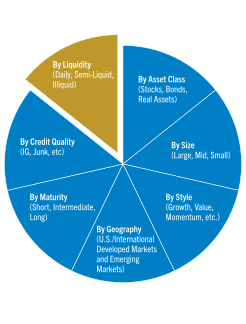
Allocators avidly exploit this one free lunch by diversifying across multiple dimensions. They build portfolios that include a variety of asset classes, from equities and bonds to real assets and beyond; they include assets that range across size or market cap; they diversify by investment styles, most commonly across value and growth; they allocate across geographies, from U.S. and international developed markets to emerging and frontier markets; in bonds, they diversify across maturity and duration buckets, as well as credit quality, from investment grade (IG) to high yield (see Exhibit 1).
But when it comes to liquidity, the vast majority of individual investor portfolios remain allocated upwards of 99% to intraday (exchange-traded funds [ETFs] and stocks) or daily liquid (mutual fund) vehicles. We want to probe this prejudice against assets that are not immediately convertible to cash and explore its potential consequences. The proposal is simple: Consider a new dimension for potential diversification by including exposure to assets and vehicles that offer different degrees of liquidity.
Note: For illustrative purposes only.
In the case of private market assets, the absence of a public secondary market to enable price discovery and regular trading defines these assets as illiquid. Studied by academics and actively pursued by institutional allocators, illiquidity offers the potential for enhanced performance through a long-term return premium.¹
One of the contributing factors behind the illiquidity premium is behavior-based: the commonly held preference for assets that can be immediately converted to cash. The premium compensates investors for giving up daily liquidity, rewarding those who commit capital for longer periods. Other drivers of the return premium in private markets include their greater complexity and customization of structures and more rigorous underwriting and diligence involved. For investors with a long-term orientation, this premium can be a powerful return enhancer.
As an example, private direct lending has historically delivered an average illiquidity premium of approximately 200 basis points (bps) over the publicly traded broadly syndicated loan market—a spread that has remained more or less consistent over time (see Exhibit 2). Academics also find similarly sized illiquidity premia for other private market assets in equities and real estate.²
Average Annualized Returns (and Return Premium) 2016–2025
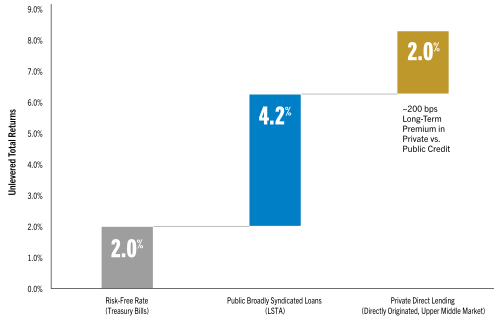
Source: Cliffwater. Reflects average quarterly figures from June 30, 2016 through June 30, 2025.
Beyond the return premium at the asset-class level, illiquid and semi-liquid investment vehicles offer another key benefit: materially lower experienced volatility.
Unlike their publicly traded counterparts, private or non-traded fund vehicles are not listed on public exchanges, insulating them from daily price swings driven by investor sentiment or stressed liquidity in public markets. Private or non-traded BDCs, for example, are valued quarterly (or monthly) based on the actual performance of underlying assets rather than speculative, moment-to-moment trading activity. This allows investment managers to prioritize credit quality, income generation and long-term value, rather than focusing on short-term share price movements or managing for potential near-term redemption requests. They may provide a more stable experience for investors with the patience to endure less-than-daily liquidity (see Exhibit 3, left side).
Measured over a nearly 20-year period, non-traded BDCs experienced a standard deviation of less than 4%, compared to a volatility of over 27% for public BDCs (see Exhibit 3, right side). Lower price volatility contributes to reduced drawdowns during periods of market stress and greater consistency of returns over time. It can also improve investor behavior, as stable valuations discourage reactive selling and short-term decision-making. Historical performance has shown that private BDCs often outperform their publicly traded peers on a risk-adjusted basis, delivering broadly similar returns with less volatility—a clear advantage for investors seeking stable, income-oriented exposure.
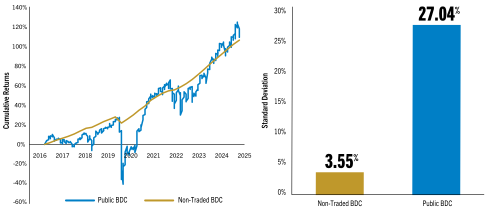
Note: Public BDC refers to the MVIS US Business Development Companies Index. Private or Non-Traded BDC refers to the Cliffwater Direct Lending Index (CDLI). Left Chart: Figures reflect total cumulative returns. Right Chart: Reflects the annualized standard deviation based on quarterly returns from July 1, 2007 to March 31, 2025. Source: Bloomberg; Cliffwater.
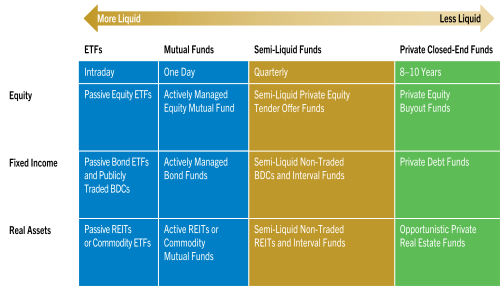
To illustrate the range of less-liquid offerings of the key asset classes, we lay out a “liquidity continuum” moving from daily liquid or even intraday funds all the way to the 10-plus-year lock-up required by private closed-end drawdown funds, with several options in between. Just as investors can diversify across assets, they can diversify across liquidity, and liquidity can be measured by the underlying asset class or by the investment vehicles that deliver the underlying exposure.
ETFs trade intraday, offering near-immediate conversion to cash, while mutual funds offer T+1 liquidity, requiring a day for funds to be converted and transferred from the manager to individual client accounts. At the other extreme of the continuum, most private closed-end funds have no liquidity provision at all and require much greater patience from investors; the typical term of these structures is 10 years, often with two one-year extensions, applied at the discretion of the manager (see Exhibit 4).
Between these two poles of the liquidity continuum, there exists a happy medium, referred to as “semi-liquid” on this page. These consist of structures that generally promise quarterly liquidity, capped at 5% of a fund’s net asset value (NAV) per quarter—a structure that could reduce individual client payouts in the event that many shareholders exit simultaneously.
These semi-liquid funds—non-traded real estate investment trusts (REITs), non-traded BDCs, interval funds and tender offer funds—provide a middle way between long-duration drawdown options and far-more-common daily liquid mutual funds and ETFs. But what are some of the consequences of diversifying into these less-liquid structures? What do investors get for suffering this exposure to less-liquid holdings?
A Liquidity Continuum Across Assets
Note: For illustrative purposes only.
It’s reasonable that investors would want to establish a framework for determining an appropriate allocation to less-liquid exposures. On this topic, balance is everything—investors must align their liquidity profiles and spending needs with their broader investment objectives. The first step is to measure the expected investment benefits (or liabilities) from diversifying into semi-liquid exposures.
For this analysis, we examine a generic individual investor portfolio allocated to 60% equities and 40% debt; the debt allocation is equally split between core bonds and public broadly syndicated loans.³ Looking over the last 20 years, rebalancing annually and applying industry-level fees, we estimate annualized net total returns of 7.8%, 11% volatility and a 2.6% income yield for this portfolio (see Exhibit 5).⁴
If we simply swap the public loan allocation for a private, non-traded direct lending portfolio, we see a notable change in annualized performance over the past 20 years: 8.3% total returns, 10.2% volatility and 3.4% income yield. The improvement runs across all dimensions of performance, resulting in a higher Sharpe ratio—the essential metric to gauge portfolio efficiency.
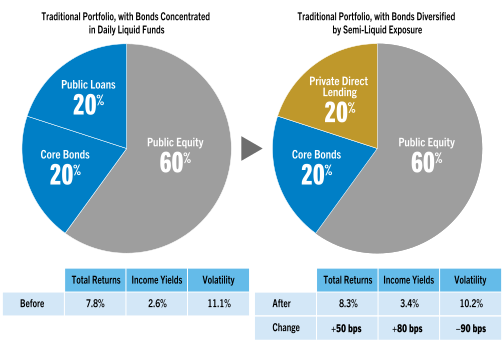
Note: Equities and bond returns are represented by the S&P 500 and Bloomberg US Agg, respectively. Direct lending is represented by the unlevered CDLI. Net income and total return are reduced by estimated fund-level fees and expenses totaling 193 bps. Stock and bond income/total return are reduced by estimated fees equal to 42 bps and 65 bps, respectively. Time period analyzed is Q4 2004 (since CDLI inception) to Q2 2024; returns and volatilities are presented on an annualized basis. Suggested allocations will vary depending on constraints applied; recommended sourcing is derived from many factors, including relative correlations, volatilities, returns and income for each asset alone and in combination with the other two.
In addition to the investment consequences, deciding on a correct and sustainable budget for any semi-liquid exposure also depends on the client’s spending rate—when and how much they expect to draw from the portfolio. A higher spending rate with larger near-term liabilities would suggest a lower allocation to semi-liquid investments, and vice versa. Let’s ground this with a simple example.
Assume a generic 3% spending rate on a $1 million portfolio. That translates to $30,000 in annual client outlays.⁵ The original portfolio, split between equities, bonds and public syndicated loans, generates about $26,000 in annual income, falling short of the spending target.⁶ By contrast, the “new” portfolio, with a 20% allocation to private direct lending, would deliver approximately $34,000 in pre-tax annual income (3.4% annualized on $1 million), topping the client’s spending target. The private loan component itself delivers more than half of the new portfolio’s total annual income (about $19,000).⁷ And in the event of additional unforeseen client costs, 80% of the portfolio ($800,000) remains in daily liquid exposure, some of which could be converted to cash at any time to meet urgent spending needs (see Exhibit 6).
Now let’s imagine the semi-liquid allocation during a period of stress. Consider a simplified scenario: A $10 billion semi-liquid fund is forced to implement a continuous 5% of NAV per quarter redemption constraint for one year. Assuming a stable NAV, that translates to approximately $500 million in redemptions per quarter, or just under $2 billion over the year. In this scenario, individual investors would still be able to redeem a portion of their holdings on a quarterly basis. For the sake of argument, if a client’s redemptions were prorated under the same “5% of NAV” constraint, they could still withdraw approximately $40,000 over the course of one year from a $200,000 allocation—enough to meet their annual spending needs.
The liquidity available from both portfolio-generated income and redeemable assets can serve as a meaningful buffer to support ongoing spending. Taken together, they may offer clients a reasonable level of comfort, allowing for suitable and effective individual investor allocations to semi-liquid assets. By assessing the investment benefits of a semi-liquid allocation alongside each client’s liquidity and spending needs, we believe advisors can design portfolios with a blended liquidity profile, introducing a new dimension of liquidity to enable truly diversified portfolio construction.
Assumes 3% Annual Client Spending on $1 Million Portfolio
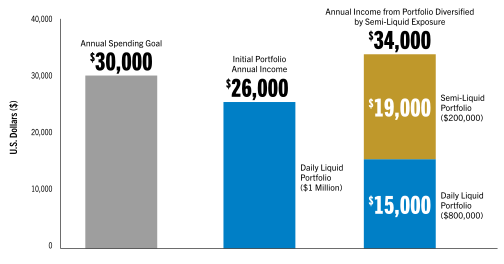
Note: For illustrative purposes only
1. See, for example, “Demystifying Illiquid Assets: Expected Returns for Private Equity” in The Journal of Alternative Investments, Winter 2020, Volume 22, Issue 3.
2. “Three Models of the Liquidity Premium,” Baz, Han, Loo, in The Journal of Portfolio Management, March 15, 2025.
3. We use the Bloomberg U.S. Aggregate for core bonds and the Morningstar LSTA Index for public broadly syndicated loans.
4. To get apples-to-apples net-of-fee returns, we use asset-weighted numbers from the 2025 Investment Company Fact Book for public equities and bonds and from the CLDI for private credit.
5. These ongoing costs are often covered by some portion of a client’s salary, government benefits or a standing cash allocation, but for the purposes of this analysis, we require the investment portfolio to provide for annual spending.
6. As with all the calculations in this analysis, total returns and income returns are gross of tax. One’s spending rate may not incur taxes, but their income does.
7. Based on a 9.5% income-oriented return (the annualized returns for direct lending according to the CDLI) on the $200,000 semi-liquid allocation.
In this document, the terms “Golub Capital” and “Firm” (and, in responses to questions that ask about the management company, general partner or variants thereof, the terms “Management Company” and “General Partner”) refer, collectively, to the activities and operations of Golub Capital LLC, GC Advisors LLC (“GC Advisors”), GC OPAL Advisors LLC (“GC OPAL Advisors”) and their respective affiliates or associated investment funds. A number of investment advisers, such as GC Investment Management LLC (“GC Investment Management”), Golub Capital Liquid Credit Advisors, LLC (Management Series) and OPAL BSL LLC (Management Series) (collectively, the “Relying Advisers”) are registered in reliance upon GC OPAL Advisors’ registration. The terms “Investment Manager” or the “Advisers” may refer to GC Advisors, GC OPAL Advisors (collectively the “Registered Advisers”) or any of the Relying Advisers. For additional information about the Registered Advisers and the Relying Advisers, please refer to each of the Registered Advisers’ Form ADV Part 1 and 2A on file with the SEC. Certain references to Golub Capital relating to its investment management business may include activities other than the activities of the Advisers or may include the activities of other Golub Capital affiliates in addition to the activities of the Advisers. This document may summarize certain terms of a potential investment for informational purposes only. In the case of conflict between this document and the organizational documents of any investment, the organizational documents shall govern.
Information is current as of the stated date and may change materially in the future. Golub Capital undertakes no duty to update any information herein. Golub Capital makes no representation or warranty, express or implied, as to the accuracy or completeness of the information herein.
Views expressed represent Golub Capital’s current internal viewpoints and are based on Golub Capital’s views of the current market environment, which is subject to change. Certain information contained in these materials discusses general market activity, industry or sector trends or other broad-based economic, market or political conditions and should not be construed as investment advice. There can be no assurance that any of the views or trends described herein will continue or will not reverse. Forecasts, estimates and certain information contained herein are based upon proprietary and other research and should not be interpreted as investment advice, as an offer or solicitation, nor as the purchase or sale of any financial instrument. Forecasts and estimates have certain inherent limitations, and unlike an actual performance record, do not reflect actual trading, liquidity constraints, fees, and/or other costs. In addition, references to future results should not be construed as an estimate or promise of results that a client portfolio may achieve. Past events and trends do not imply, predict or guarantee, and are not necessarily indicative of, future events or results. Private credit involves an investment in non-publicly traded securities which may be subject to illiquidity risk. Portfolios that invest in private credit may be leveraged and may engage in speculative investment practices that increase the risk of investment loss.
This presentation has been distributed for informational purposes only, and does not constitute investment advice or the offer to sell or a solicitation to buy any security. This presentation incorporates information provided by third-party sources that are believed to be reliable, but the information has not been verified independently by Golub Capital. Golub Capital makes no warranty or representation as to the accuracy or completeness of such third-party information. No part of this material may be reproduced in any form, or referred to in any other publication, without express written permission.
Past performance does not guarantee future results.
All information about the Firm contained in this document is presented as of May 2025, unless otherwise specified.
"*" indicates required fields

Find the Right Fit: Matching Asset and Vehicle Liquidity in Semi-Liquid Alternative Investments
Learn