

The democratization of alternatives is one of the most important and visible trends in the financial industry. As more individual investors pursue the return premium long associated with private market investing, identifying investment vehicles that meet their liquidity expectations has become increasingly critical. This paper explores the growth of semi-liquid alternative investment vehicles and the imperative of matching the underlying asset’s liquidity with the liquidity features of the investment vehicle itself.
To address the broad range of investor demands today, alternative investments are now offered in multiple wrappers, from illiquid multi-year drawdown funds to daily-liquid mutual funds and exchange-traded funds. Sitting in the middle are semi-liquid structures such as non-traded business development companies (BDCs), interval funds, tender offer funds and non-traded real estate investment trusts (REITs). These structures provide periodic liquidity, typically allowing redemptions of up to 5% of the vehicles’ net asset value (NAV) per quarter while providing direct exposure to various private market asset classes (see Exhibit 1).
This compromise between long-lockup and daily-liquid structures has proven attractive to individual investors. However, the semi-liquid structure alone does not guarantee a satisfactory investor experience. A critical factor is how well the structure fits with the liquidity of the underlying assets. A mismatch between the liquidity of the assets and the redemption terms of the vehicle can create challenges for investors (whether they seek to exit the fund or remain) and fund managers alike. The reality is that not all private market assets are equally suitable for inclusion in semi-liquid investment structures.
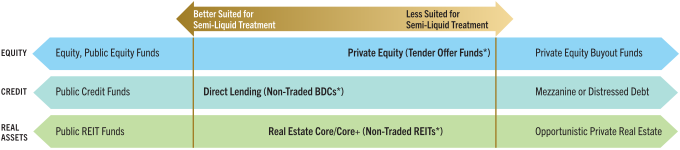
Source: Golub Capital. For illustrative purposes only.
*Non-traded BDCs, tender offer funds and non-traded REITs are three examples of “semi-liquid” alternative vehicles; they seek to provide more regular liquidity (5% a quarter, 20% per annum, as a percentage of NAV) than traditional limited partner–drawdown funds
Real estate offers a case in point. From 2015 to early 2022, investor demand for core real estate soared, with one fund receiving over $50 billion in net inflows over a three-year period.
However, when interest rates began rising in 2022, real estate valuations declined and a wave of investors sought to redeem. Because non-traded REIT liquidity is limited to 5% of NAV per quarter, redemptions quickly hit a ceiling—known as gating—leaving many investors unable to fully exit their position (see Exhibit 2).
To meet both redemption requests and required distributions, some funds depleted their liquidity sleeves (typically invested in more liquid instruments such as commercial mortgage-backed securities) or faced the difficult choice of selling real estate assets in a down market. One manager sought board approval to reduce quarterly liquidity rights from 5% to 1%—an 80% cut—shaking investor confidence.1
Another fund facing similar redemption pressures sought shareholder approval to convert from an interval fund structure to a publicly traded closed-end fund offering daily liquidity (shareholders voted down the proposal).2
These events raise important questions. Were investor expectations realistic? Did managers grow their investor base responsibly? Were liquidity mechanisms clearly disclosed? Even with prudent management, the structural limitations of core real estate (including its longer holding period) may make it difficult to meet liquidity promises during periods of stress.
Non-Traded REIT Universe Quarterly Flows ($M)
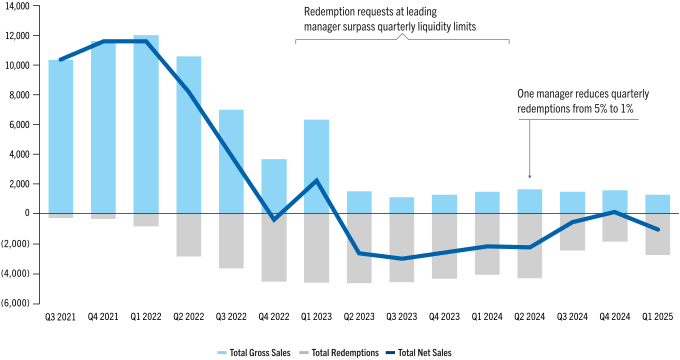
Note: Data as of March 31, 2025.
Source: Stanger Market Pulse, Alternative Investments
To illustrate the importance of asset-level liquidity, consider real estate and direct lending—two distinct asset classes that are commonly packaged in similar semi-liquid wrappers. While the liquidity of the vehicles is similar, the characteristics of the two asset classes diverge substantially.
Real Estate (via Non-Traded REITs)
Direct Lending (via Non-Traded BDCs)
The fundamental takeaway is that the loans from direct lending managers tend to amortize and return capital to investors faster. This helps align direct lending portfolios more closely than real estate assets with the semi-liquid vehicle’s liquidity profile (see Exhibit 3).
Liquidity and Cash Flow Characteristics of Direct Lending Portfolios

Note: Data as of June 30, 2024.
Source: Cliffwater Direct Lending Index.
The contrast with direct lending is important. These debt portfolios have natural turnover with an average loan life of three years, providing a buffer to help meet liquidity demands without forced asset sales.
With annual principal repayments averaging 34% and annual income returns exceeding 10%, direct lending portfolios tend to be better equipped to meet the 20% annual liquidity (5% of NAV per quarter) promised by non-traded BDCs (see Exhibit 4).
Supported by the relatively high and consistent cash flows of the underlying loans, a typical portfolio could organically generate meaningful liquidity over three years without relying on new inflows or selling assets at unfavorable prices. This balance of both asset- and vehicle-level liquidity should help managers meet redemption requests and maintain income distributions across market cycles.
Direct Lending Asset-Level Liquidity Exceeds Non-Traded BDC Vehicle Redemption Threshold
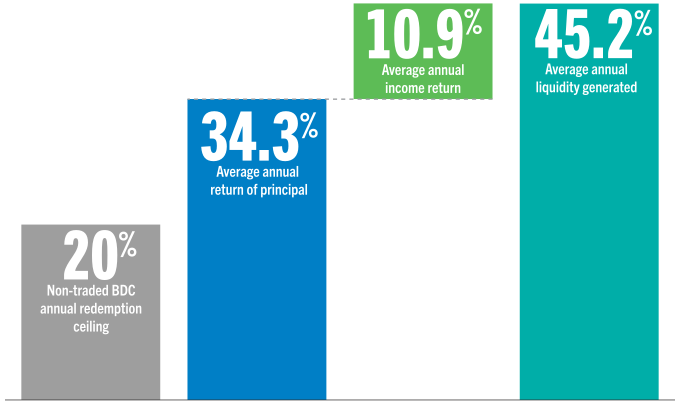
Note: Data represents average trailing four quarter returns from September 30, 2005 to June 30, 2024.
Source: Cliffwater Direct Lending Index
The lesson for advisors and investors is clear: Vehicle structure matters, but underlying asset liquidity matters as well.
The challenges faced by non-traded REITs weren’t due to market conditions alone. They reflected a deeper design flaw: promising liquidity to investors in a structure misaligned with its underlying asset-level characteristics. Real estate assets, with long holding periods and high sensitivity to rate cycles, may cause managers to periodically struggle to address short-term redemption pressures.
For many real estate investors, the experience was challenging. Promised liquidity did not always materialize; funds struggled to maintain income distributions, total return declined and NAV eroded—sometimes due to fire-sale liquidations of sizable property holdings or increasing portfolio leverage (see Exhibit 5).
Direct lending, by contrast, is generally better suited to semi-liquid structures. Its high natural turnover of capital and steady interest income provide managers with the flexibility to meet redemptions while maintaining fund stability. However, it is important to acknowledge that direct lending portfolios are not immune to stress during market dislocations, and investors should maintain realistic expectations for liquidity in times of volatility.
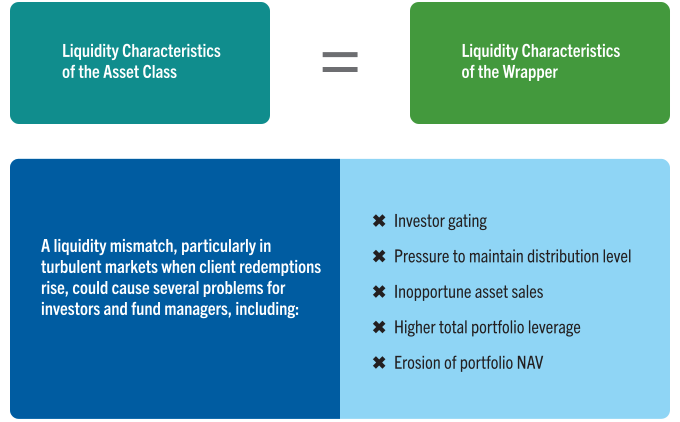
Source: Golub Capital internal analysis
1. As reported in Bloomberg article, May 23, 2024, “Starwood’s $10 Billion REIT Turns to Survival Mode as Real Estate Pain Lingers.”
2. As reported in Investment News, September 4, 2025.
3. Source: NCREIF National Property Index (NPI). The NPI provides historical measurement of the property-level returns of real estate as an institutional investment asset class
In this document, the terms “Golub Capital” and “Firm” (and, in responses to questions that ask about the management company, general partner or variants thereof, the terms “Management Company” and “General Partner”) refer, collectively, to the activities and operations of Golub Capital LLC, GC Advisors LLC (“GC Advisors”), GC OPAL Advisors LLC (“GC OPAL Advisors”) and their respective affiliates or associated investment funds. A number of investment advisers, such as GC Investment Management LLC (“GC Investment Management”), Golub Capital Liquid Credit Advisors, LLC (Management Series) and OPAL BSL LLC (Management Series) (collectively, the “Relying Advisers”) are registered in reliance upon GC OPAL Advisors’ registration. The terms “Investment Manager” or the “Advisers” may refer to GC Advisors, GC OPAL Advisors (collectively the “Registered Advisers”) or any of the Relying Advisers. For additional information about the Registered Advisers and the Relying Advisers, please refer to each of the Registered Advisers’ Form ADV Part 1 and 2A on file with the SEC. Certain references to Golub Capital relating to its investment management business may include activities other than the activities of the Advisers or may include the activities of other Golub Capital affiliates in addition to the activities of the Advisers. This document may summarize certain terms of a potential investment for informational purposes only. In the case of conflict between this document and the organizational documents of any investment, the organizational documents shall govern.
Information is current as of the stated date and may change materially in the future. Golub Capital undertakes no duty to update any information herein. Golub Capital makes no representation or warranty, express or implied, as to the accuracy or completeness of the information herein.
Views expressed represent Golub Capital’s current internal viewpoints and are based on Golub Capital’s views of the current market environment, which is subject to change. Certain information contained in these materials discusses general market activity, industry or sector trends or other broad-based economic, market or political conditions and should not be construed as investment advice. There can be no assurance that any of the views or trends described herein will continue or will not reverse. Forecasts, estimates and certain information contained herein are based upon proprietary and other research and should not be interpreted as investment advice, as an offer or solicitation, nor as the purchase or sale of any financial instrument. Forecasts and estimates have certain inherent limitations, and unlike an actual performance record, do not reflect actual trading, liquidity constraints, fees, and/or other costs. In addition, references to future results should not be construed as an estimate or promise of results that a client portfolio may achieve. Past events and trends do not imply, predict or guarantee, and are not necessarily indicative of, future events or results. Private credit involves an investment in non-publicly traded securities which may be subject to illiquidity risk. Portfolios that invest in private credit may be leveraged and may engage in speculative investment practices that increase the risk of investment loss. This presentation has been distributed for informational purposes only, and does not constitute investment advice or the offer to sell or a solicitation to buy any security. This presentation incorporates information provided by third-party sources that are believed to be reliable, but the information has not been verified independently by Golub Capital. Golub Capital makes no warranty or representation as to the accuracy or completeness of such third-party information. No part of this material may be reproduced in any form, or referred to in any other publication, without express written permission.
Past performance does not guarantee future results.
All information about the Firm contained in this document is presented as of September 2025, unless otherwise specified.
The Morningstar Indexes are the exclusive property of Morningstar, Inc. Morningstar, Inc., its affiliates and subsidiaries, its direct and indirect information providers and any other third party involved in, or related to, compiling, computing or creating any Morningstar Index (collectively, “Morningstar Parties”) do not guarantee the accuracy, completeness and/or timeliness of the Morningstar Indexes or any data included therein and shall have no liability for any errors, omissions, or interruptions therein. None of the Morningstar Parties make any representation or warranty, express or implied, as to the results to be obtained from the use of the Morningstar Indexes or any data included therein.
“Cliffwater,” “Cliffwater Direct Lending Index,” and “CDLI” are trademarks of Cliffwater LLC. The Cliffwater Direct Lending Indexes (the “Cliffwater Indexes”) and all information on the performance or characteristics thereof (“Cliffwater Index Data”) are owned exclusively by Cliffwater LLC, and are referenced herein under license. Neither Cliffwater nor any of its affiliates sponsor or endorse, or are affiliated with or otherwise connected to, Golub Capital, or any of its products or services. All Cliffwater Index Data is provided for informational purposes only, on an “as available” basis, without any warranty of any kind, whether express or implied. Cliffwater and its affiliates do not accept any liability whatsoever for any errors or omissions in the Cliffwater Indexes or Cliffwater Index Data, or arising from any use of the Cliffwater Indexes or Cliffwater Index Data, and no third party may rely on any Cliffwater Indexes or Cliffwater Index Data referenced in this report. No further distribution of Cliffwater Index Data is permitted without the express written consent of Cliffwater. Any reference to or use of the Cliffwater Index or Cliffwater Index Data is subject to the further notices and disclaimers set forth from time to time on Cliffwater’s website.
"*" indicates required fields
Patient Capital and Liquid Diversification: The Opportunity in Semi-Liquid Private Markets
Learn