

Direct Lenders as Private Equity Continuation Partners
Defining the “Natural” Manager for
GP-Led Secondaries Investing
- Commentary
- GP-led secondaries have grown into a distinct segment of the secondary market, with investment characteristics that differ meaningfully from traditional LP-led secondaries.
- GP-led secondaries investing requires two core capabilities: (i) sponsor relationships to gain privileged access to GP-led processes and (ii) underwriting capabilities to evaluate individual assets with sufficient depth and expertise.
- Direct lenders may be well suited for GP-led secondaries investing given their position in the private equity (PE) ecosystem and extensive experience underwriting sponsor-backed companies.
GP-led secondaries—also known as continuation vehicles (CVs)—are the fastest-growing puzzle piece in the PE ecosystem. But success in GP-led secondaries investing requires a different set of skills than investing in PE funds or traditional secondary funds. In this paper, we look at key enabling factors for success. One involves the scarcity premium: the ability to gain privileged access to sponsor-led processes and participate among a limited syndicate of investors. Another is a proven underwriting skillset that extends across three dimensions: (i) industry sector expertise, (ii) knowledge of the underlying company and (iii) a deep understanding of the GP’s strengths and incentives. We believe direct lenders, who have been the financing providers to PE deals for decades, are rare in combining these skills.
Evolution of Secondaries Investing
Secondary market PE investing emerged decades ago in response to a practical need: providing liquidity for LPs seeking to sell otherwise illiquid fund interests.
In the early development of the secondary market, the essential characteristic of a secondary manager was that of a broker: the ability to make a market between buyers and sellers of illiquid assets, often at meaningful valuation discounts, while managing the technical, legal and regulatory elements of the transaction. This helps explain why many fund-of-funds managers, who historically mediated large-scale fund interactions between LP end clients and GP sponsors, grew into the largest secondary managers, with PE secondaries becoming a successful and important asset class for these institutions.
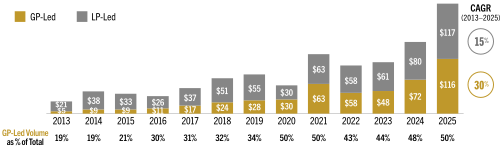
Over the last decade, the traditional LP secondary market has grown, while GP-led secondaries have concurrently scaled into a separate category in their own right (see Exhibit 1). While both LP-led and GP-led transactions remain important parts of the secondary market, they feature distinct investment characteristics, with important implications for the type of manager best suited to deliver investor value.
Exhibit 1
GP-Led Secondaries Have Scaled into a Category of Their Own
GP-Led and LP-Led Secondary Transaction Volume
Source: Lazard, “Secondary Market for 2025.” Data as of February 2026.
GP-Led Secondaries: A Different Investment Proposition
Traditional secondary funds have often appealed to investors seeking to mitigate the J-curve typical in primary fund investing, gain broad diversification in a single allocation and achieve a quick step-up in value from discounted entry pricing, with a potentially shorter path to distributions from seasoned portfolios.
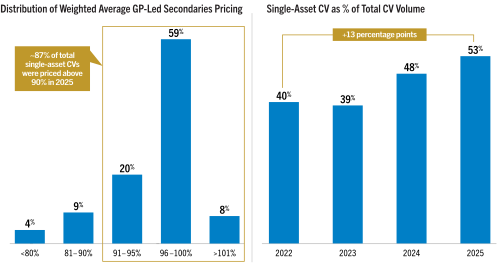
GP-led secondaries share some of these benefits, but the core investment proposition is different. CVs are often centered on sponsors’ “crown jewel” assets, increasingly structured as single-asset investments, and tend to have limited valuation discounts (see Exhibit 2). The investment thesis is therefore driven less by discount capture and more by the quality of an individual business and the go-forward value-creation opportunity. This does not make GP-led deals inherently better or worse than LP-led secondaries. But it requires both a recalibration of investor objectives and a fundamental rethink about what makes a good manager in this newer segment of the secondary market.
Exhibit 2
GP-Led Secondaries Are Less Discount-Driven and Increasingly Single-Asset
Source: Lazard, “Secondary Market for 2025.” Data as of February 2026.
The Core Capability Set for GP-Led Secondaries Investing: Seeking the “Natural” Manager
So, what capabilities matter for GP-led secondaries investing? Two are especially important: sponsor relationships and underwriting rigor. The first determines whether a manager can see and secure attractive opportunities. The second determines whether the manager can evaluate those opportunities with sufficient underwriting depth and expertise.
Sponsor relationships matter because GP-led transactions are highly controlled processes. The average CV includes only a small syndicate of investors, while the sponsor retains significant influence over investor selection and allocations. As a result, access to attractive opportunities is often determined by the strength of an investor’s relationship with the sponsor and its reputation as a value-adding long-term partner. For example, sponsors may place a premium on repeat partners that have demonstrated reliable execution and that can bring a “vote of confidence” to their deals through their perceived investing acumen.
Underwriting rigor is important because of concentrated asset-level exposure. CVs typically offer targeted exposure to a single, high-conviction investment selected by the sponsor, but that concentration raises the stakes of asset selection. Investors therefore need a deeper understanding of the underlying business, the management team and the sponsor executing the value creation plan.
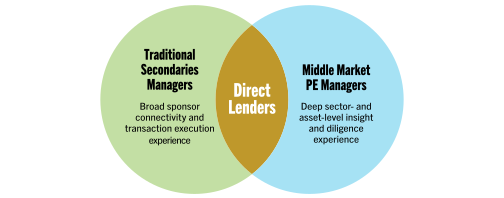
Few manager models naturally combine both capabilities (see Exhibit 3). Traditional transaction-oriented secondaries firms have a strong historical claim to the market, given their broad access to PE sponsors and long-standing role as intermediaries between LPs and GPs. They maintain fund interests across the vintages of different sponsor funds, receive recurring fund reporting and engage regularly with fund Investor Relations teams. These attributes are valuable in LP-led secondaries, where sourcing, pricing and executing fund-interest transactions are central to the value proposition. But the concentrated exposure of a CV calls for granular company-level diligence and sector-specific underwriting—a more asset-focused discipline than the manager-focused orientation at the heart of traditional secondaries.
PE firms typically have teams of experienced deal professionals with expertise in modeling and underwriting individual company assets. But these organizations lack the coverage and depth of access across the full PE landscape that traditional secondaries firms have built, and their participation in “crown jewel” asset investing could present competitive concerns to CV sponsors.
This is where direct lenders have the potential to bridge the gap, especially those with a long history of partnering with PE sponsors and conducting diligence on PE-backed portfolio companies. In a market where both access and underwriting matter, that combination offers a differentiated value.
Exhibit 3
Finding the Natural Manager for GP-Led Secondaries
Few manager types combine relationship-driven access to sponsor-led opportunities with the sector- and asset-level insight needed for company-level diligence.
Source: Golub Capital.
Why Direct Lenders May Be Naturally Positioned
The case for sponsor finance-focused platforms starts with where they sit in the market. Their core business places them in regular dialogue with PE sponsors and close to the companies those sponsors own. That positioning aligns closely with the core demands of continuation investing.
Sponsor Access and Intelligence
The access advantage is not simply a function of knowing many sponsors; it comes from the depth and history of those partnerships, built over years of working hand in hand on shared transactions (see Exhibit 4). Regular touchpoints and sponsor coverage embedded throughout the organization create early visibility into portfolio company developments and potential secondaries opportunities. A sponsor evaluating a small syndicate of investors may place significant weight on prior relationship history and execution credibility. They may also prefer experienced lending partners over peer PE investors where information-sharing or competitive sensitivities exist.
Importantly, long-term sponsor relationships can translate into more informed judgment. Over years of collaboration, a direct lender can develop a deep understanding of a sponsor’s investment philosophy, value-creation approach and portfolio management style. That context can be particularly useful when assessing a sponsor’s rationale for retaining a “crown jewel” asset and evaluating whether the proposed continuation plan is consistent with the sponsor’s demonstrated strengths. In a market where PE firms are increasingly differentiated by their operational capabilities, understanding the sponsor behind the transaction can be as important as understanding the asset itself.
Exhibit 4
Golub Capital’s Broad, Long-Standing Sponsor Relationships
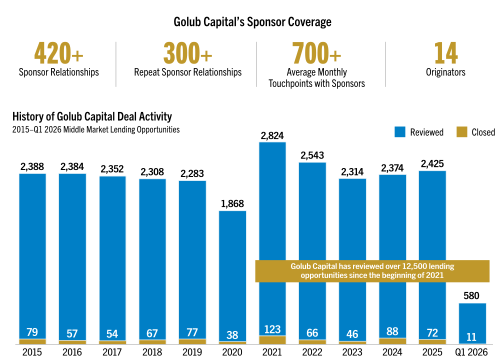
Note: Sponsor relationships formed by Golub Capital since Firm’s inception.
Source: Golub Capital.
Asset-Level Expertise and Differentiated Perspective
GP-led CV activity is concentrated in sectors that overlap meaningfully with key areas of direct lending activity (see Exhibit 5). That overlap is important because direct lenders repeatedly evaluate individual businesses in these sectors across issuers, sponsors and cycles. This can build pattern recognition around what drives durable performance in these sectors, such as revenue quality, customer concentration, cyclicality, cash flow conversion, leverage capacity and exit risk.
This accumulated experience can also create an information advantage at the company level. In some cases, the manager may have direct familiarity with the asset through an existing or a prior lending relationship. In others, it may have evaluated the company in a financing process or monitored adjacent credits with similar industry dynamics. These channels can provide further insight into company performance and industry trends beyond traditional sponsor and LP reporting.
Exhibit 5
Golub Capital’s Underwriting Expertise Matches the GP-Led Secondaries Opportunity Set
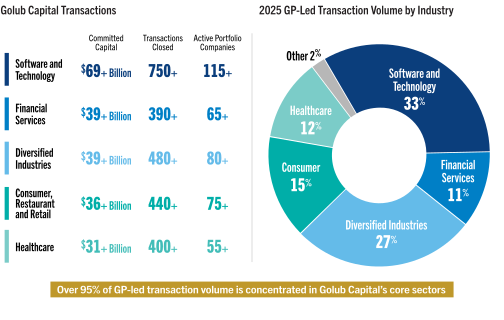
Source (left side): Golub Capital. Data as of March 31, 2026. Reflects number of transactions closed and dollar amounts of capital committed since 2013. Based on the marketing verticals and may be monitored by multiple teams across different verticals across the Firm.
Source (right side): Evercore 2025 Secondary Market Report.
In addition, a credit-first lens can strengthen equity-oriented analysis by bringing discipline around capital protection. A common skepticism is that lenders may be too focused on what can go wrong to fully underwrite the growth-oriented thesis behind a continuation vehicle. However, this skepticism overlooks an important context of direct lending. At the high levels of leverage typical of PE-owned companies, an enterprise value cushion from growth and value creation is essential to the underwriting process. Rarely is it the case that a lender can get comfortable with a highly leveraged asset without some confidence in the company’s growth plan. Direct lenders are also accustomed to ensuring alignment with management by studying equity ownership plans and their relationship to “market.” Whether it is for a regular term loan or a delayed draw term loan to support further investment, lenders are highly attuned to the ROI of growth initiatives such as add-on acquisitions, platform expansions, working capital investments, management augmentations, sales strategy investments and a myriad of other operational initiatives. This work requires judgment on the same fundamentals that underpin a CV investment thesis, with the added discipline of testing whether the business has the financial resilience required if execution takes longer or if market and funding conditions become less favorable.
Taken together, these attributes make experienced direct lenders to sponsor-backed companies a natural fit for GP-led secondaries investing. Traditional secondary credentials still matter, but they are not the only factor defining the right manager for this market. The optimal manager may be the long-term financing partner to the sponsor already embedded in the PE ecosystem: one that understands the GP behind the transaction and the company and management team expected to deliver the next phase of value creation.
Disclaimer
In this document, the terms “Golub Capital” and “Firm” (and, in responses to questions that ask about the management company, general partner or variants thereof, the terms “Management Company” and “General Partner”) refer, collectively, to the activities and operations of Golub Capital LLC, GC Advisors LLC (“GC Advisors”), GC OPAL Advisors LLC (“GC OPAL Advisors”) and their respective affiliates or associated investment funds. Certain affiliated advisers are included as relying advisers (“Relying Advisers”) under GC OPAL Advisors’ umbrella registration, as described in its Form ADV. The terms “Investment Manager” or the “Advisers” may refer to GC Advisors, GC OPAL Advisors (collectively the “Registered Advisers”) or any of the Relying Advisers. For additional information about the Registered Advisers and the Relying Advisers, please refer to each of the Registered Advisers’ Form ADV Part 1 and 2A on file with the SEC. Certain references to Golub Capital relating to its investment management business may include activities other than the activities of the Advisers or may include the activities of other Golub Capital affiliates in addition to the activities of the Advisers. This document may summarize certain terms of a potential investment for informational purposes only. In the case of conflict between this document and the organizational documents of any investment, the organizational documents shall govern.
Information is current as of the stated date and may change materially in the future. Golub Capital undertakes no duty to update any information herein. Golub Capital makes no representation or warranty, express or implied, as to the accuracy or completeness of the information herein.
Views expressed represent Golub Capital’s current internal viewpoints and are based on Golub Capital’s views of the current market environment, which is subject to change. Certain information contained in these materials discusses general market activity, industry or sector trends or other broad-based economic, market or political conditions and should not be construed as investment advice. There can be no assurance that any of the views or trends described herein will continue or will not reverse. Forecasts, estimates and certain information contained herein are based upon proprietary and other research and should not be interpreted as investment advice, as an offer or solicitation, nor as the purchase or sale of any financial instrument. Forecasts and estimates have certain inherent limitations, and unlike an actual performance record, do not reflect actual trading, liquidity constraints, fees, and/or other costs. In addition, references to future results should not be construed as an estimate or promise of results that a client portfolio may achieve. Past events and trends do not imply, predict or guarantee, and are not necessarily indicative of, future events or results. Private credit involves an investment in non-publicly traded securities which may be subject to illiquidity risk. Portfolios that invest in private credit may be leveraged and may engage in speculative investment practices that increase the risk of investment loss.
This presentation has been distributed for informational purposes only, and does not constitute investment advice or the offer to sell or a solicitation to buy any security. This presentation incorporates information provided by third-party sources that are believed to be reliable, but the information has not been verified independently by Golub Capital. Golub Capital makes no warranty or representation as to the accuracy or completeness of such third-party information. No part of this material may be reproduced in any form, or referred to in any other publication, without express written permission.
Past performance does not guarantee future results.
All information about the Firm contained in this document is presented as of June 2026, unless otherwise specified.
20260914.GC.WP