

We see evidence of crowding specifically in the large market space among publicly traded alternative managers. These multi‑asset alternative firms have had a clear impact on the private credit landscape by raising significant amounts of capital with an investment focus away from core middle market borrowers ($20–100 million EBITDA); instead, they focus almost exclusively on large market borrowers ($100+ million EBITDA). This should be no surprise. These firms were purpose‑built to “go big” in order to rapidly grow their assets under management (and fee‑based earnings) for public shareholders. The result is…a crowded market…but mostly in the large market space. While large market deals may be episodically attractive, we believe there’s an advantage in selective deal sourcing across the entire middle market universe.
Many investors ask whether the private credit market has gotten more crowded: We say it depends where you look.
The broad “core” of the middle market direct lending asset class (representing borrowers with average weighted EBITDA of $20–100 million) has, by and large, retained its contours and characteristics over time. However, at the outer edge of the asset class, we’ve witnessed a kind of selective hypertrophy, focused almost exclusively in the “upper middle” or large market. This outsized growth is due to the recent entry of a rather small number of super‑sized funds, managed typically by publicly traded alternative managers.
Signs of this bulge bracket intrusion in middle market lending are clear when looking, over time, at the average weighted EBITDA of borrowers across the direct lending market.
From 2014 through 2019, during a period of robust investor interest and asset growth in the middle market space (thanks in part to modest yields available from traditional fixed income during this time), the average direct lending borrower EBITDA edged up only modestly, rising 16% from $43 million to $50 million. But as several new publicly traded alternative managers entered the space, beginning around 2020, the borrower profile shifted significantly: Average EBITDA increased 90%, from $50 million to $95 million (see Exhibit 1).
Weighted Average Borrower EBITDA in Direct Lending ($ in millions)
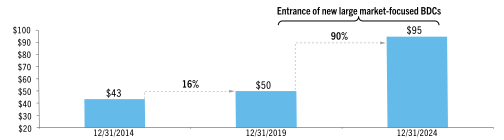
Source: Lincoln International and Golub Capital internal analysis. Borrower EBITDA represents the average EBITDA for all securities in the Lincoln Senior Debt Index. The Lincoln Senior Debt Index is a quarterly index that tracks the fair market value of 1,600 middle market direct lending credit investments every quarter across approximately 175+ fund clients in the United States and in Europe. The reflected data is as of December 31, 2024.
This large market approach by just a handful of BDCs had a tectonic impact on the middle market space in terms of growth, creating a kind of parallel universe in the asset class. This is evident in the sheer size and speed of asset growth among BDCs.
Over the first 20 years of this century, the middle market direct lending asset category, as measured by the BDC universe (comprising both publicly traded and non‑traded BDCs), grew to $126 billion in total assets—to be clear, that includes assets raised cumulatively over 20 years. But in just the last four years, six newly launched non‑traded BDCs have raised a larger amount of capital ($141 billion) all on their own. In just four years, and attributable to just six newly launched funds, the private credit BDC space has more than doubled in size (see Exhibit 2).
Raising this amount of capital in such a short period is a significant achievement, but there’s little secret in how it was done: These newcomer BDCs are getting big by buying big. They were able to achieve enormous scale over such a short period of time by targeting only the largest of private borrowers, lending to companies with an average EBITDA of $241 million.
But beyond their commitment to large market borrowers, these new BDC entrants share several other characteristics.
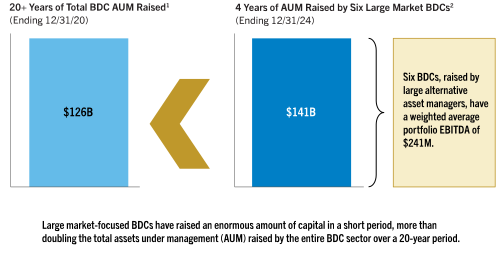
1. Source: Total BDC capital raised used total AUM from Cliffwater’s Direct Lending Index. Based on market data as of December 31, 2024.
2. Source: Stanger Market Pulse, BDC monthly fact sheets, company presentations, SEC filings and Golub Capital internal analysis. BDC cohort consists of six largest private BDCs that report a weighted average EBITDA. Based on market data as of December 31, 2024.
The BDCs that have helped drive this asset class shift to higher EBITDA companies share similar characteristics:
At the end of the day, these funds are obliged to “go big” when it comes to both asset gathering and, relatedly, the size of their individual deals. So, when public alternative asset managers advertise the particular virtues of large market lending, the truth of the claim should be assessed: They have little choice but to target these types of investments.
But away from debatable marketing assertions, is there any broader concern associated with this type of growth occurring in the traditional direct lending market? These large market private credit lenders are creeping into public credit territory, competing with broadly syndicated loans and high yield and clouding some important distinctions between public and private credit.
The large market BDCs occupy a form of “gray zone” between the less liquid private middle market and more liquid public credit markets. We believe these are two distinct asset categories, each with unique characteristics, attracting different types of investors with varying costs of capital. For example, broadly syndicated loans (BSLs) typically have lower rates, fewer covenant protections and higher leverage compared to private middle market loans. Competing in this gray zone can result in a blending or blurring of terms between the BSL market and private direct lending (see Exhibit 3).
Public vs. Private Lending Spectrum and the Battle Within
Non-bank lenders have replaced banks as the main source of debt capital for private equity-backed middle market companies for reasons that go well beyond bank regulatory capital constraints.
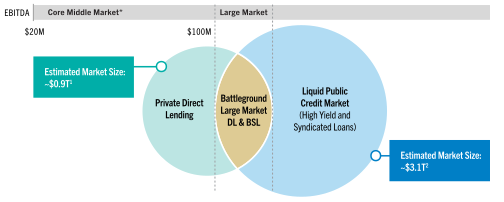
1. Source: Private middle market direct lending represents total direct lending assets under management of $594 billion from Preqin’s database plus $325 billion of public BDCs and perpetually private BDCs from Cliffwater’s Direct Lending Index. The data is as of September 30, 2024.
2. Source: Syndicated loan market of $1.4 trillion represents par amount of total U.S. loans in Morningstar’s LSTA U.S. Leveraged Loan Index. Sourced from Pitchbook LCD’s “U.S. Loan Stats Weekly Trend” report as of November 15, 2024. High yield market $1.7 trillion represents total outstanding from S&P U.S. High Yield Corporate Bond Index. Sourced from Pitchbook LCD’s “Interactive High-Yield” Report as of October 31, 2024.
*Note: This presentation defines the core middle market generally as borrowers with $20-100 million of EBITDA and the large market segment generally as borrowers with over $100 million of EBITDA.
To be clear, we do not seek to apply value judgments to any segment of the market or to argue that “large is bad” or “it’s better in the middle.” Both approaches may deliver differentiated results for investors relative to their public credit peers. But their virtues are neither monolithic nor unchanging. In other words, the relative attractiveness of large market or traditional core middle market lending opportunities will vary over time, just like any other investment.
At times, investing in large market deals may look appealing. But we do not believe large market lending is best all the time, especially when the liquid credit markets are functioning well. Instead, we believe a higher value proposition lies in being able to lend across the entire direct lending size spectrum—from lower middle to core middle and beyond.
But that requires a lot of resources, a good deal of experience, incumbencies across the sponsor and middle market company landscape and other strengths that we, in particular, have spent years developing. The important point is not to be beholden to any one segment of the market simply due to the external requirement for rapid and continuous growth. That would limit the opportunity set and reduce the diversification inherent in the broad middle market direct lending universe.
In this document, the terms “Golub Capital” and “Firm” (and, in responses to questions that ask about the management company, general partner or variants thereof, the terms “Management Company” and “General Partner”) refer, collectively, to the activities and operations of Golub Capital LLC, GC Advisors LLC (“GC Advisors”), GC OPAL Advisors LLC (“GC OPAL Advisors”) and their respective affiliates or associated investment funds. A number of investment advisers, such as GC Investment Management LLC (“GC Investment Management”), Golub Capital Liquid Credit Advisors, LLC (Management Series) and OPAL BSL LLC (Management Series) (collectively, the “Relying Advisers”) are registered in reliance upon GC OPAL Advisors’ registration. The terms “Investment Manager” or the “Advisers” may refer to GC Advisors, GC OPAL Advisors (collectively the “Registered Advisers”) or any of the Relying Advisers. For additional information about the Registered Advisers and the Relying Advisers, please refer to each of the Registered Advisers’ Form ADV Part 1 and 2A on file with the SEC. Certain references to Golub Capital relating to its investment management business may include activities other than the activities of the Advisers or may include the activities of other Golub Capital affiliates in addition to the activities of the Advisers. This document may summarize certain terms of a potential investment for informational purposes only. In the case of conflict between this document and the organizational documents of any investment, the organizational documents shall govern.
Information is current as of the stated date and may change materially in the future. Golub Capital undertakes no duty to update any information herein. Golub Capital makes no representation or warranty, express or implied, as to the accuracy or completeness of the information herein.
Views expressed represent Golub Capital’s current internal viewpoints and are based on Golub Capital’s views of the current market environment, which is subject to change. Certain information contained in these materials discusses general market activity, industry or sector trends or other broad-based economic, market or political conditions and should not be construed as investment advice. There can be no assurance that any of the views or trends described herein will continue or will not reverse. Forecasts, estimates and certain information contained herein are based upon proprietary and other research and should not be interpreted as investment advice, as an offer or solicitation, nor as the purchase or sale of any financial instrument. Forecasts and estimates have certain inherent limitations, and unlike an actual performance record, do not reflect actual trading, liquidity constraints, fees, and/or other costs. In addition, references to future results should not be construed as an estimate or promise of results that a client portfolio may achieve. Past events and trends do not imply, predict or guarantee, and are not necessarily indicative of, future events or results. Private credit involves an investment in non-publicly traded securities which may be subject to illiquidity risk. Portfolios that invest in private credit may be leveraged and may engage in speculative investment practices that increase the risk of investment loss.
This presentation has been distributed for informational purposes only, and does not constitute investment advice or the offer to sell or a solicitation to buy any security. This presentation incorporates information provided by third-party sources that are believed to be reliable, but the information has not been verified independently by Golub Capital. Golub Capital makes no warranty or representation as to the accuracy or completeness of such third-party information. No part of this material may be reproduced in any form, or referred to in any other publication, without express written permission.
Past performance does not guarantee future results.
All information about the Firm contained in this document is presented as of January 2026, unless otherwise specified.
The Morningstar Indexes are the exclusive property of Morningstar, Inc. Morningstar, Inc., its affiliates and subsidiaries, its direct and indirect information providers and any other third party involved in, or related to, compiling, computing or creating any Morningstar Index (collectively, “Morningstar Parties”) do not guarantee the accuracy, completeness and/or timeliness of the Morningstar Indexes or any data included therein and shall have no liability for any errors, omissions, or interruptions therein. None of the Morningstar Parties make any representation or warranty, express or implied, as to the results to be obtained from the use of the Morningstar Indexes or any data included therein.
“Cliffwater,” “Cliffwater Direct Lending Index,” and “CDLI” are trademarks of Cliffwater LLC. The Cliffwater Direct Lending Indexes (the “Cliffwater Indexes”) and all information on the performance or characteristics thereof (“Cliffwater Index Data”) are owned exclusively by Cliffwater LLC, and are referenced herein under license. Neither Cliffwater nor any of its affiliates sponsor or endorse, or are affiliated with or otherwise connected to, Golub Capital, or any of its products or services. All Cliffwater Index Data is provided for informational purposes only, on an “as available” basis, without any warranty of any kind, whether express or implied. Cliffwater and its affiliates do not accept any liability whatsoever for any errors or omissions in the Cliffwater Indexes or Cliffwater Index Data, or arising from any use of the Cliffwater Indexes or Cliffwater Index Data, and no third party may rely on any Cliffwater Indexes or Cliffwater Index Data referenced in this report. No further distribution of Cliffwater Index Data is permitted without the express written consent of Cliffwater. Any reference to or use of the Cliffwater Index or Cliffwater Index Data is subject to the further notices and disclaimers set forth from time to time on Cliffwater’s website.
"*" indicates required fields
A Short History of Sponsor Finance: The Evolution of Bank and Non-Bank Participation in Middle Market Lending
Learn