
Some commentators have described payment-in-kind (PIK) interest as being everywhere and always a sign of borrower distress. In reality, private credit providers often offer PIK to the very best borrowers. For good borrowers, PIK options (whether utilized or not) can enhance borrower flexibility and increase both equity and lender returns. When structured thoughtfully, PIK options can support growth, preserve liquidity, provide an alternative to more expensive equity financing and align with long-term value creation. This paper explores the forms, timing and intent behind PIK, helping investors distinguish between cases where PIK is a sign of strength and where it is a sign of weakness. The key is not to fear PIK but to understand it.
Over the past decade, and particularly since the COVID-19 pandemic, PIK interest has evolved from a niche structuring tool into a mainstream feature of private credit (see Exhibit 1). This expansion has also sparked concern—and, at times, confusion—among investors. A frequently asked question is, “What percentage of the portfolio is PIK?” Often, this single number is used (incorrectly) as a proxy for assessing portfolio stress, rooted in the historical association of PIK with distressed borrowers or subordinated debt—typically used when companies lack the liquidity to service cash interest.
However, this view is increasingly being seen as outdated.
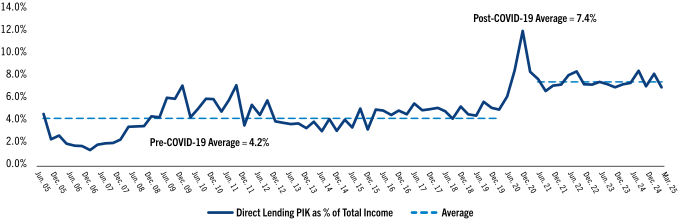
In today’s direct lending environment, PIK has also become a flexible, strategic feature—not just a signal of distress. Private credit lenders are now incorporating PIK into select new senior secured loans as part of a customized financing solution designed to accelerate growth. In these cases, PIK is not a red flag. It is a feature, not a flaw: It gives borrowers the flexibility to reinvest cash into expansion while enhancing lender economics through higher yields.
In other scenarios, of course, PIK may be introduced to support a borrower facing financial pressure. In those cases, too, it is typically accompanied by improved terms for the lender and/or additional support from the private equity sponsor, such as a cash equity infusion. These structures can preserve value and create a bridge to recovery rather than signal inevitable impairment.
Understanding these nuances is essential to accurately assessing the risk and opportunity that PIK presents in a modern credit portfolio.
At its core, PIK interest is a mechanism that allows borrowers to defer cash interest payments by capitalizing them—essentially adding the accrued interest to the principal balance of the loan. This structure enhances borrower liquidity (allowing them to use cash for other purposes, not the payment of quarterly loan interest), while lenders are compensated through a growing loan balance and, typically, a higher overall yield.
The PIK payment structure can take several forms, each with distinct implications for both borrower and lender.
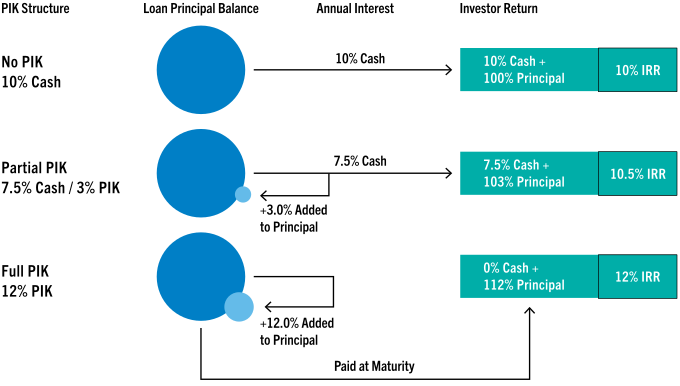
Source: Golub Capital internal analysis. For illustrative purposes only.
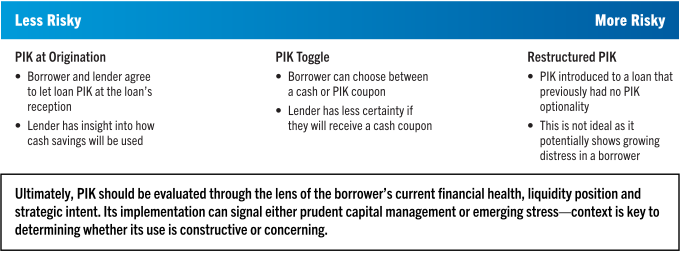
PIK interest is often misunderstood as a blanket indicator of borrower distress. A common investor question—“What percentage of the portfolio is paying PIK?”—oversimplifies a nuanced credit feature. The reality is that PIK must be evaluated through the lens of its context, timing and underlying borrower fundamentals.
PIK at Origination: A Strategic Tool
When PIK is structured at the time of origination—particularly for healthy, resilient businesses—it is typically part of a deliberate, risk-calibrated strategy. In these cases, PIK is negotiated to support growth, manage liquidity or align with a borrower’s capital deployment plan. Far from being a red flag, this form of PIK can enhance flexibility and enable value creation without compromising credit quality.
PIK “Toggle”: For Borrower Optionality
PIK toggle structures, which allow borrowers to switch between cash and in-kind interest at will, introduce more complexity. PIK toggles are typically temporary in nature, often lasting two years, and are designed to provide short-term flexibility. The rationale behind the toggle is critical. A borrower opting for PIK to reinvest in high-return growth opportunities presents a vastly different credit profile than one toggling due to liquidity constraints or deteriorating fundamentals. In this case, investor judgment and borrower transparency are key.
“Mid-Life” PIK Amendments (Restructured PIK): A Signal, Not a Sentence
When PIK is introduced mid-loan via amendment, it typically reflects emerging stress. This may indicate a weakening financial position or a need to preserve cash. However, it can still be a value-preserving move—particularly when paired with meaningful concessions from the borrower, such as a sponsor equity infusion or an operational turnaround plan. In these cases, lenders may view temporary PIK relief as a bridge to recovery, not a path to impairment.
The bottom line: context is everything. PIK should not be viewed as inherently good or bad. Instead, it should be assessed based on:
When tied to a fundamentally sound business, PIK can be a smart, risk-adjusted feature that supports long-term value creation. When linked to a distressed borrower, it may signal elevated risk. Even then, however, it can be part of a thoughtful restructuring strategy. For investors, the key is not to fear PIK but to understand it. A nuanced view enables better risk assessment, more informed portfolio monitoring and, ultimately, stronger credit outcomes.
Note: Synthetic PIK is excluded from this chart. Synthetic PIK refers to situations where a borrower uses another form of debt, such as drawing on a revolving credit facility or delayed draw term loan, to fund cash interest payments. While not as contractually structured as PIK, it has a similar economic effect by increasing leverage and preserving cash, effectively adding debt to the borrower’s balance sheet.
Source: Golub Capital internal analysis. For illustrative purposes only
The recent rise in PIK interest across direct lending markets has prompted an important question from investors: “Is this a sign of growing borrower stress or a reflection of private credit’s evolving sophistication?” As with most credit dynamics, the answer is nuanced. There are two fundamental drivers behind the rise in PIK.
PIK as a Competitive Structuring Tool
One key driver of the growth of PIK is its increased use as a proactive structuring feature that lenders can deploy for prospective borrowers. Direct lenders are including PIK—particularly toggle features—at origination to offer more flexible, bespoke financing solutions that appeal to sponsors and borrowers. PIK gives borrowers more tools in their toolkit to navigate changing environments, allowing them to manage interest obligations across a range of base rate scenarios or other potential liquidity headwinds. Private direct lenders may view their provision of PIK as a powerful inducement when dealing with larger borrowers who might otherwise seek funding in public markets (where PIK loans are much rarer).
According to S&P Global, a 2024 review of over 300 private credit agreements found that 41% of large market deals (loan sizes of >$750M) included a PIK toggle feature, compared to just 7% in the middle market (loan sizes of <$750M) (see Exhibit 4). This underscores how the availability of PIK has become a differentiator for private direct lenders in competitive deal environments, particularly at the upper end of the market, which competes with the broadly syndicated loan market.
PIK as a Reactive Liquidity Tool
At the same time, some borrowers are turning to PIK out of necessity. During periods of higher interest rates, companies facing margin compression or liquidity constraints may activate toggle features or seek amendments to convert cash interest into partial or full PIK. These reactive uses of PIK, especially when tied to deteriorating fundamentals, can be more concerning and may signal elevated credit risk.
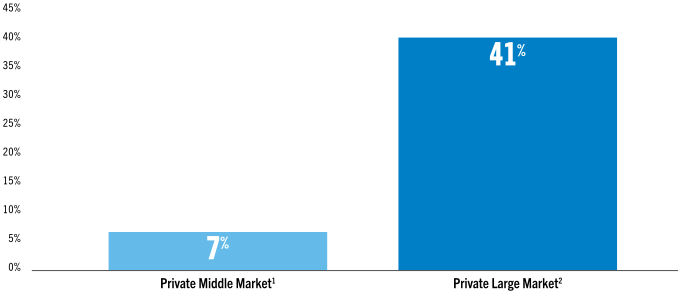
Source: S&P Global Ratings’ “Private Credit And Middle-Market CLO Quarterly: Unknown Unknowns Q2 2025”. S&P Global reviewed 304 credit agreements executed in 2024 to identify loan structures with a PIK toggle.
1. Private Middle Market comprises loans of $750 million or less. The Private Middle Market loan data set includes 250 private credit agreements with 17 PIK toggle features.
2. Private Large Market comprises loans greater than $750 million. The Private Large Market loan data set includes 54 private credit agreements with 22 PIK toggle features.
The growth in PIK reflects both structural innovation and cyclical pressure. On one hand, it enhances the private credit value proposition through flexibility and customization. On the other, it can serve as a short-term bridge for borrowers under financial strain.
Recent data illustrates this duality. Structured PIK—where PIK is embedded at origination—began rising in 2021 as lenders increasingly used it to offer bespoke financing solutions to larger borrowers entering the market (see Exhibit 5). This trend leveled off by 2023, suggesting normalization of the feature in deal structuring. In contrast, materially modified PIK—defined as amendments where the PIK spread increases by 250 basis points or more—began climbing in late 2022, coinciding with the lagging impact of the Federal Reserve’s rate hikes as borrowers sought relief from rising debt service costs.
Importantly, structured PIK and materially modified PIK have contributed roughly equally to the rise of PIK over the past four years, underscoring that this growth is driven by a blend of structuring innovation and reactive adjustments, not by a single factor. Together, these trends reinforce the fact that PIK growth is not monolithic. Understanding which dynamic is at play is essential to interpreting the credit signal behind PIK.
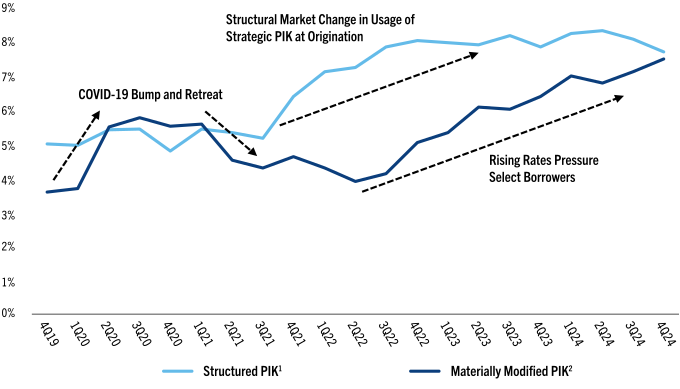
Source: Golub Capital internal analysis utilizing the underlying data set provided by Raymond James Research. The data set represents approximately $160 billion in business development company assets under management as of December 31, 2024.
1. Structured PIK refers to loans that included a PIK component at origination, where the PIK spread has not materially changed post-origination (defined as a change of less than 25 basis points).
2. Materially Modified PIK refers to loans where a PIK component was either introduced post-origination or the existing PIK spread had increased by 250 basis points or more.
In this document, the terms “Golub Capital” and “Firm” (and, in responses to questions that ask about the management company, general partner or variants thereof, the terms “Management Company” and “General Partner”) refer, collectively, to the activities and operations of Golub Capital LLC, GC Advisors LLC (“GC Advisors”), GC OPAL Advisors LLC (“GC OPAL Advisors”) and their respective affiliates or associated investment funds. A number of investment advisers, such as GC Investment Management LLC (“GC Investment Management”), Golub Capital Liquid Credit Advisors, LLC (Management Series) and OPAL BSL LLC (Management Series) (collectively, the “Relying Advisers”) are registered in reliance upon GC OPAL Advisors’ registration. The terms “Investment Manager” or the “Advisers” may refer to GC Advisors, GC OPAL Advisors (collectively the “Registered Advisers”) or any of the Relying Advisers. For additional information about the Registered Advisers and the Relying Advisers, please refer to each of the Registered Advisers’ Form ADV Part 1 and 2A on file with the SEC. Certain references to Golub Capital relating to its investment management business may include activities other than the activities of the Advisers or may include the activities of other Golub Capital affiliates in addition to the activities of the Advisers. This document may summarize certain terms of a potential investment for informational purposes only. In the case of conflict between this document and the organizational documents of any investment, the organizational documents shall govern.
Information is current as of the stated date and may change materially in the future. Golub Capital undertakes no duty to update any information herein. Golub Capital makes no representation or warranty, express or implied, as to the accuracy or completeness of the information herein.
Views expressed represent Golub Capital’s current internal viewpoints and are based on Golub Capital’s views of the current market environment, which is subject to change. Certain information contained in these materials discusses general market activity, industry or sector trends or other broad-based economic, market or political conditions and should not be construed as investment advice. There can be no assurance that any of the views or trends described herein will continue or will not reverse. Forecasts, estimates and certain information contained herein are based upon proprietary and other research and should not be interpreted as investment advice, as an offer or solicitation, nor as the purchase or sale of any financial instrument. Forecasts and estimates have certain inherent limitations, and unlike an actual performance record, do not reflect actual trading, liquidity constraints, fees, and/or other costs. In addition, references to future results should not be construed as an estimate or promise of results that a client portfolio may achieve. Past events and trends do not imply, predict or guarantee, and are not necessarily indicative of, future events or results. Private credit involves an investment in non-publicly traded securities which may be subject to illiquidity risk. Portfolios that invest in private credit may be leveraged and may engage in speculative investment practices that increase the risk of investment loss.
This presentation has been distributed for informational purposes only, and does not constitute investment advice or the offer to sell or a solicitation to buy any security. This presentation incorporates information provided by third-party sources that are believed to be reliable, but the information has not been verified independently by Golub Capital. Golub Capital makes no warranty or representation as to the accuracy or completeness of such third-party information. No part of this material may be reproduced in any form, or referred to in any other publication, without express written permission.
Past performance does not guarantee future results.
All information about the Firm contained in this document is presented as of January 2026, unless otherwise specified.
The Morningstar Indexes are the exclusive property of Morningstar, Inc. Morningstar, Inc., its affiliates and subsidiaries, its direct and indirect information providers and any other third party involved in, or related to, compiling, computing or creating any Morningstar Index (collectively, “Morningstar Parties”) do not guarantee the accuracy, completeness and/or timeliness of the Morningstar Indexes or any data included therein and shall have no liability for any errors, omissions, or interruptions therein. None of the Morningstar Parties make any representation or warranty, express or implied, as to the results to be obtained from the use of the Morningstar Indexes or any data included therein.
“Cliffwater,” “Cliffwater Direct Lending Index,” and “CDLI” are trademarks of Cliffwater LLC. The Cliffwater Direct Lending Indexes (the “Cliffwater Indexes”) and all information on the performance or characteristics thereof (“Cliffwater Index Data”) are owned exclusively by Cliffwater LLC, and are referenced herein under license. Neither Cliffwater nor any of its affiliates sponsor or endorse, or are affiliated with or otherwise connected to, Golub Capital, or any of its products or services. All Cliffwater Index Data is provided for informational purposes only, on an “as available” basis, without any warranty of any kind, whether express or implied. Cliffwater and its affiliates do not accept any liability whatsoever for any errors or omissions in the Cliffwater Indexes or Cliffwater Index Data, or arising from any use of the Cliffwater Indexes or Cliffwater Index Data, and no third party may rely on any Cliffwater Indexes or Cliffwater Index Data referenced in this report. No further distribution of Cliffwater Index Data is permitted without the express written consent of Cliffwater. Any reference to or use of the Cliffwater Index or Cliffwater Index Data is subject to the further notices and disclaimers set forth from time to time on Cliffwater’s website.
"*" indicates required fields