

Imagine sitting through your 20th private credit panel this year. Manager A takes the mic and declares that the large borrower market is the only place to be—citing its scale and stability. Moments later, Manager B counters with a passionate defense of the lower middle market, praising its wider spreads and tighter covenants. So, who’s right? Neither. We regard the fixation on borrower size as a distraction. A truer north star in credit investing involves identifying resilient businesses, maintaining strict documentation and pricing risk correctly—none of which has to do with check size.
One question has come to dominate recent discussions around private credit: Is it better to invest with lenders who focus more exclusively on large borrowers or those who limit themselves to smaller companies occupying the so‑called “lower middle market” (LMM), or some other sub‑category of the “middle market”?
Proponents on either side of this debate often cite selective data to support their claims—some touting the presumed stability of larger borrowers, others emphasizing reduced competition in smaller deals. Both arguments appear tendentious, aimed at marketing a manager’s chosen strategy rather than a meaningful effort to address fundamental questions about the asset class.
We reject the premise that any arbitrarily determined segment of the borrower size spectrum consistently delivers superior risk‑adjusted returns across all market and economic environments.
That’s a form of tunnel vision (see Exhibit 1). Borrower size is just one of many variables that matter in private credit. It follows that decisions around manager selection should not be based on company size alone.
Tunnel Vision Limits Opportunity
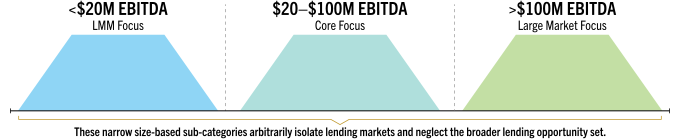
Golub Capital internal analysis. For illustrative purposes only.
Borrower size is not a static or reliable proxy for risk or return in direct lending. Each of the size segments referenced by managers—large market, core middle market and LMM—offers distinct characteristics that shift with market conditions. Rigidly focusing on a single sub‑category of the middle market simply limits a manager’s potential access to higher‑quality businesses across the segments.
That’s not to say that there are no relevant trade‑offs between borrower size segments—there are. Large market loans are typically made to more mature businesses with greater management depth and stability. But these virtues come with some corresponding drawbacks: tighter spreads, higher borrower leverage and looser documentation.
In contrast, LMM loans typically feature wider spreads, lower borrower leverage and stronger documentation. But these loans are often made to businesses with a greater reliance on a small group of executives, more customer concentration and a narrower product line (see Exhibit 2).
These trade‑offs highlight why borrower size alone should not dictate one’s investment strategy. A more flexible approach, prioritizing best‑in‑class businesses and being responsive to changes in market conditions, can unlock value across the size spectrum.
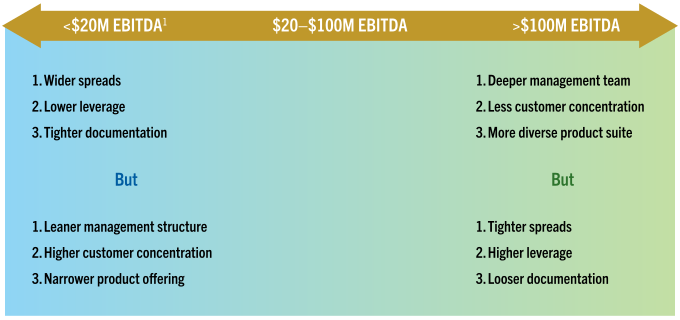
Source: Lincoln International, S&P Global Ratings and Golub Capital Internal Analysis. For illustrative purposes only. The spread and leverage analysis is based on spread and leverage terms from a data set consisting of more than 1,600 private credit transactions tracked by Lincoln International from 2018 through 2024. The covenant analysis is based on the presence of maintenance covenants across different size loan tranches from a data set consisting of more than 1,200 private credit agreements reviewed by S&P Global. As of December 31, 2024.
1. EBITDA is defined as earnings before interest, taxes, depreciation and amortization.
When a private credit manager emphasizes the size range of the borrowers they serve, it says more about the firm itself (its origin, relationships and platform constraints) than about its distinction as a lender. In fact, building the scale and infrastructure to lend across the size spectrum is not easily done.
It demands a robust platform—deep sponsor relationships, experienced underwriting teams and sophisticated portfolio monitoring. In the core middle market and LMM, deal flow is relationship‑driven, built over years of consistent engagement with sponsors, advisors and borrowers. Success in this space requires significant investment in people, infrastructure and reputation. The commitment to resourcing is unavoidable (and costly) for those few managers intent on sourcing borrowers from across the broad middle market landscape.
By contrast, large market lending can be more transactional—often driven by capital availability and check size—and have far leaner staffing requirements given its narrower scope and emphasis on borrower scale. Managers oriented more exclusively to larger borrowers tend to be themselves large, publicly traded and multi‑asset in nature, with substantial fundraising goals and corresponding deployment needs (see Exhibit 3).
We believe the payoff for investing across the size spectrum consists of more than just reach—it diversifies portfolio construction and can strengthen risk management. Managers who limit themselves to a single borrower segment may face a narrower opportunity set, which in some cases could lead to “trading down” within that segment, simply to meet deployment goals. In contrast, those with the flexibility to lend across the size spectrum can dynamically pursue top‑tier businesses wherever they reside. This broader aperture not only expands manager access to a larger number of higher‑quality deals but also enables managers to be more responsive to changing market conditions, as the relative appeal of certain sectors or businesses can vary over time.
There’s another perspective to consider as well—the private equity (PE) sponsor’s. Maintaining a core group of trusted lending partners is essential for a PE sponsor’s business model. These sponsors cannot sustain close alliances with an unlimited number of lenders, so they naturally prioritize those with the strongest capabilities and a track record of repeat collaboration. A private credit provider that can execute across a wide range of deal sizes, not just a narrow slice of the middle market, offers a more compelling and strategic partnership. This flexibility not only enhances the lender’s platform but also deepens relationships with sponsors, positioning the lender as a preferred partner to the broader PE ecosystem.
Number of Credit Investment Professionals per Billion of Credit AUM
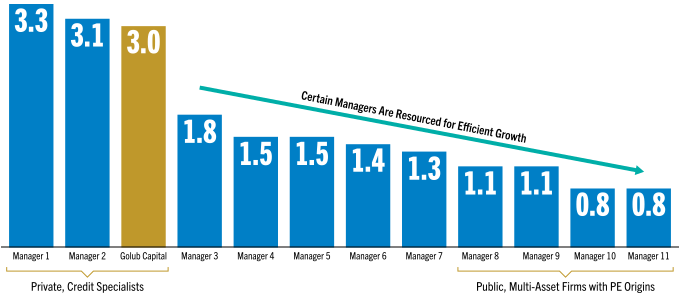
Source: Company filings, company websites and press releases. Credit manager cohort consists of publicly traded alternative asset managers, top-five largest non-traded business development companies (BDCs) managers and top-five managers in Pitchbook’s “Q2 2024 U.S. PE Middle-Market Lending League Tables.” Based on market data as of September 30, 2024.
The ability to lend across the full borrower size continuum offers a less frequently discussed but highly valuable benefit to select managers: incumbency. Providing capital to lower or core middle market companies with strong growth potential allows lenders to build deep relationships and institutional knowledge early in a company’s lifecycle. As these businesses grow into core middle market or even large market borrowers, their original lenders, armed with years of insight and alignment, are uniquely positioned to support their next phase of growth.
This relationship can extend even further: As some borrowers transition into the public markets, their long‑time private credit partners may continue to participate as holders of syndicated debt, benefiting from a meaningful informational edge over other market participants.
The ability to scale alongside portfolio companies, supporting them through multiple stages of growth and across market cycles, is a rare and powerful advantage of a broad middle market lending strategy.
Golub Capital’s Direct Lending Median Borrower EBITDA at Initial Transaction Close and June 30, 2025
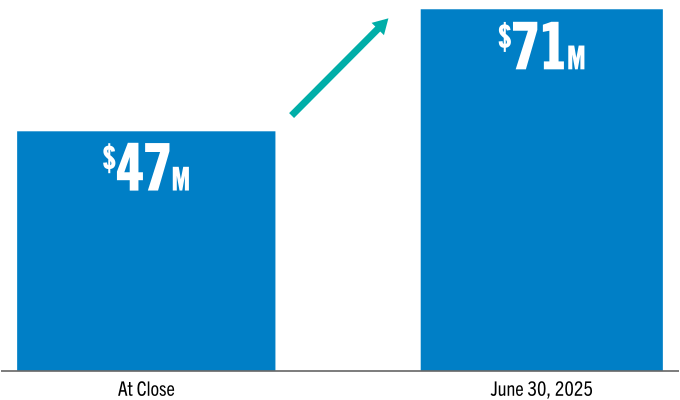
Source: Golub Capital internal analysis as of June 30, 2025. The median EBITDA are based on our portfolio of debt investments and exclude investments designated as recurring revenue and broadly syndicated loans.
Borrower size is a variable, not a strategy. Allocating capital dynamically across the size spectrum, rather than adhering to a single segment, provides a competitive edge. Lenders can capitalize on large market opportunities during favorable conditions there or shift to the core middle market when structural advantages in that range better align with market dynamics. This flexibility is more likely to result in well‑balanced portfolios and consistent risk‑adjusted returns across cycles.
Rejecting the false dichotomy of “large vs. small” enables a renewed emphasis on credit discipline, focusing on resilient business and long‑term alignment. In a market defined by crowding and compression, a strategy rooted in a broad opportunity set and rigorous selectivity may deliver superior outcomes for investors, capturing high‑quality deals regardless of where they may lie on the borrower size spectrum.
Distribution of Golub Capital Originations: January 1, 2019–December 31, 2024
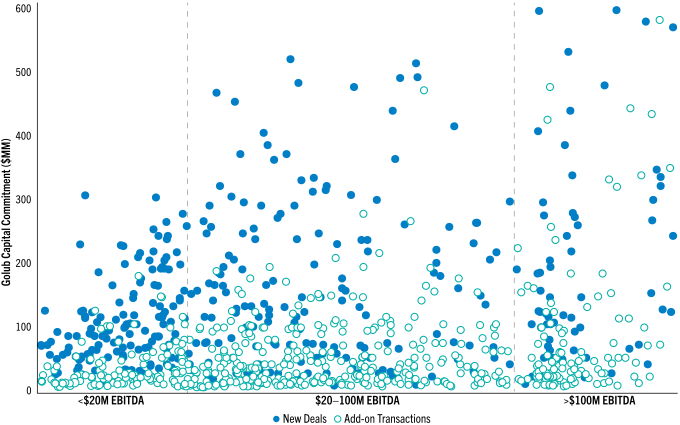
1. Based on dollar value of debt financing commitments to middle market companies within each EBITDA range at underwriting. The scatterplot excludes 52 deals that we believe are not representative of a typical Golub Capital middle market origination.
2. Includes the deals excluded in the scatterplot.
3. Based on count of new deals and add-on transactions.
Note: Past performance does not guarantee future results.
Source: Golub Capital. As of December 31, 2024.
In this document, the terms “Golub Capital” and “Firm” (and, in responses to questions that ask about the management company, general partner or variants thereof, the terms “Management Company” and “General Partner”) refer, collectively, to the activities and operations of Golub Capital LLC, GC Advisors LLC (“GC Advisors”), GC OPAL Advisors LLC (“GC OPAL Advisors”) and their respective affiliates or associated investment funds. A number of investment advisers, such as GC Investment Management LLC (“GC Investment Management”), Golub Capital Liquid Credit Advisors, LLC (Management Series) and OPAL BSL LLC (Management Series) (collectively, the “Relying Advisers”) are registered in reliance upon GC OPAL Advisors’ registration. The terms “Investment Manager” or the “Advisers” may refer to GC Advisors, GC OPAL Advisors (collectively the “Registered Advisers”) or any of the Relying Advisers. For additional information about the Registered Advisers and the Relying Advisers, please refer to each of the Registered Advisers’ Form ADV Part 1 and 2A on file with the SEC. Certain references to Golub Capital relating to its investment management business may include activities other than the activities of the Advisers or may include the activities of other Golub Capital affiliates in addition to the activities of the Advisers. This document may summarize certain terms of a potential investment for informational purposes only. In the case of conflict between this document and the organizational documents of any investment, the organizational documents shall govern.
Information is current as of the stated date and may change materially in the future. Golub Capital undertakes no duty to update any information herein. Golub Capital makes no representation or warranty, express or implied, as to the accuracy or completeness of the information herein.
Views expressed represent Golub Capital’s current internal viewpoints and are based on Golub Capital’s views of the current market environment, which is subject to change. Certain information contained in these materials discusses general market activity, industry or sector trends or other broad-based economic, market or political conditions and should not be construed as investment advice. There can be no assurance that any of the views or trends described herein will continue or will not reverse. Forecasts, estimates and certain information contained herein are based upon proprietary and other research and should not be interpreted as investment advice, as an offer or solicitation, nor as the purchase or sale of any financial instrument. Forecasts and estimates have certain inherent limitations, and unlike an actual performance record, do not reflect actual trading, liquidity constraints, fees, and/or other costs. In addition, references to future results should not be construed as an estimate or promise of results that a client portfolio may achieve. Past events and trends do not imply, predict or guarantee, and are not necessarily indicative of, future events or results. Private credit involves an investment in non-publicly traded securities which may be subject to illiquidity risk. Portfolios that invest in private credit may be leveraged and may engage in speculative investment practices that increase the risk of investment loss.
This presentation has been distributed for informational purposes only, and does not constitute investment advice or the offer to sell or a solicitation to buy any security. This presentation incorporates information provided by third-party sources that are believed to be reliable, but the information has not been verified independently by Golub Capital. Golub Capital makes no warranty or representation as to the accuracy or completeness of such third-party information. No part of this material may be reproduced in any form, or referred to in any other publication, without express written permission.
Past performance does not guarantee future results.
All information about the Firm contained in this document is presented as of January 2026, unless otherwise specified.
The Morningstar Indexes are the exclusive property of Morningstar, Inc. Morningstar, Inc., its affiliates and subsidiaries, its direct and indirect information providers and any other third party involved in, or related to, compiling, computing or creating any Morningstar Index (collectively, “Morningstar Parties”) do not guarantee the accuracy, completeness and/or timeliness of the Morningstar Indexes or any data included therein and shall have no liability for any errors, omissions, or interruptions therein. None of the Morningstar Parties make any representation or warranty, express or implied, as to the results to be obtained from the use of the Morningstar Indexes or any data included therein.
“Cliffwater,” “Cliffwater Direct Lending Index,” and “CDLI” are trademarks of Cliffwater LLC. The Cliffwater Direct Lending Indexes (the “Cliffwater Indexes”) and all information on the performance or characteristics thereof (“Cliffwater Index Data”) are owned exclusively by Cliffwater LLC, and are referenced herein under license. Neither Cliffwater nor any of its affiliates sponsor or endorse, or are affiliated with or otherwise connected to, Golub Capital, or any of its products or services. All Cliffwater Index Data is provided for informational purposes only, on an “as available” basis, without any warranty of any kind, whether express or implied. Cliffwater and its affiliates do not accept any liability whatsoever for any errors or omissions in the Cliffwater Indexes or Cliffwater Index Data, or arising from any use of the Cliffwater Indexes or Cliffwater Index Data, and no third party may rely on any Cliffwater Indexes or Cliffwater Index Data referenced in this report. No further distribution of Cliffwater Index Data is permitted without the express written consent of Cliffwater. Any reference to or use of the Cliffwater Index or Cliffwater Index Data is subject to the further notices and disclaimers set forth from time to time on Cliffwater’s website.
"*" indicates required fields
Crowded Market in Private Credit? Enter the Large, Public Alternative Managers
Learn