

There’s a saying, “If you’ve met one opportunistic credit fund… you’ve met one opportunistic credit fund.” The category lacks definition. In fact, it’s less a category than a concept (Preqin doesn’t even include “opportunistic” as one of the subgroups within private credit).
The fact is, most firms conceive of it as differently as they do their own businesses. Depending on which manager you speak to, “opportunistic” can mean:
How can we better understand opportunistic credit, if not as an asset class per se, then at least as a more clearly defined investment strategy?
We consider three pillars in our definition.
In short, we believe opportunistic credit, done right, is less an asset class and more a business—a relationship business.
The level of supply or demand for credit is constantly in flux. There are many participants in the broad credit ecosystem who are periodically starved of liquidity and factors that, at different points in time, tend to constrain its availability or complicate its delivery. Three ingredients are often at work here.
Sources of Liquidity: Traditional sources of liquidity (banks, collateralized loan obligations [CLOs], mutual funds, exchange-traded funds [ETFs] and various private market funds) may periodically face limits on their ability to invest.
These constantly evolving imbalances of supply and demand generate ongoing funding challenges (and opportunities).
Regulatory Constraints: Factors restraining access to debt are many and varied. Some can be regulatory in nature:
Scarcity drives opportunity. These regulatory impediments to the supply of debt capital continuously generate new avenues for liquidity and sometimes novel contributors of it.
Fund Holding Periods: Other constraints on liquidity tie back to various legal strictures on the investment vehicles themselves.
All of these factors can influence the amount, availability and price of debt capital at any point in time.

Source: Golub Capital; for illustrative purposes only.
There’s Always a (Liquidity) Mismatch Happening Somewhere
Investors often assume a connection between distress and opportunity. However, this should not imply that opportunistic funds, as a rule, require market-wide dislocation to succeed.
A credit-centric understanding of the opportunistic category should not be limited to a specific point in the business cycle where periods of extreme distress may arise. While such moments may create especially attractive opportunities for credit managers, they tend to be rare and hard to time and often pass quickly.
To be truly opportunistic, by our definition, a credit manager should be continuously alert and able to identify a variety of occasions and types of investment—most of them well short of true distress. The opportunistic credit manager draws from the full toolkit of debt investing to deliver a solution most pertinent to the need at hand. The solution could be situated anywhere from senior debt at the top of the capital stack to structured or common equity at the bottom. Also, because the number and sorts of participants in the broader credit universe continue to evolve and expand, the range and scale of opportunities will only grow and develop over time.
Here are some examples, all of them short of true distress:
These may seem like unrelated transaction types. However, many of these actions and actors are intertwined—each influenced by the others’ need for and access to liquidity. And most of them occur in normal market conditions well short of deep distress.
Periods of extreme distress are not required for opportunistic credit managers to address a diverse array of liquidity needs
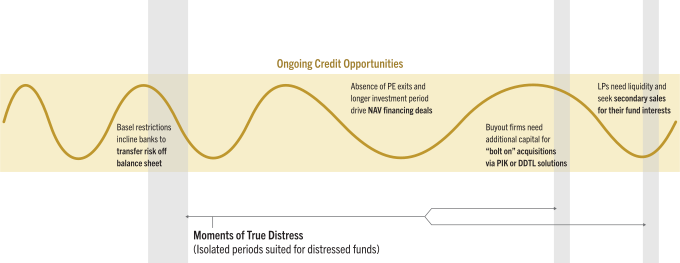
Source: Golub Capital; for illustrative purposes only.
The opportunistic credit manager most suited to identifying and addressing the liquidity challenges we’ve outlined sits at the center of a diverse community of participants. These include private fund GPs, their middle market portfolio companies, the direct lenders that supply them capital, the LPs that invest in their funds, the banks that supply fund leverage and help syndicate their public BSLs and the agents and other trading relationships in both the BSL and CLO markets. All of them, at various points in time, could be either in need of debt capital or the providers of it, or both, simultaneously.
However, it’s not enough just to be known. The successful opportunistic credit manager should have longstanding relationships with most of these actors across the debt continuum. They have deep ties running decades long with a fundamental understanding of their respective businesses and what works for each. Often, investment edge does not come from algorithms calculating the most probable next tick of a security’s price but from personal relationships and industry understanding. Two examples of this are:
The intersecting threads of information across this ecosystem of creditors and debtors create a rich network of opportunity for an attentive and connected credit manager.
Opportunistic managers occupy the center of the credit ecosystem
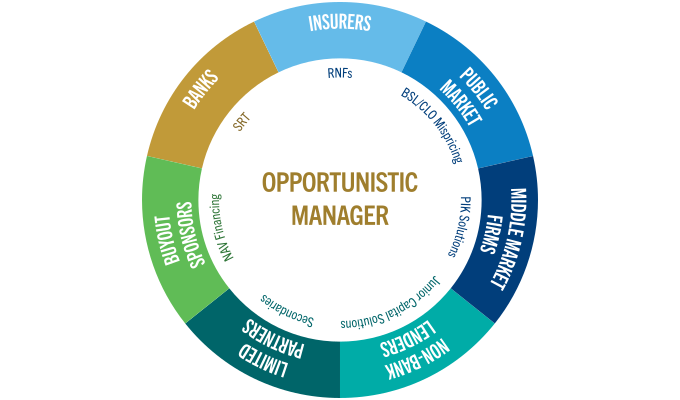
Source: Golub Capital; for illustrative purposes only.
In many ways, the space we’re identifying for an opportunistic credit strategy sits in between the more traditional and constrained domains of large-scale PE and senior-oriented direct lending. Opportunistic deals may approach the boundaries of these entrenched mandates but will tend to focus instead on the broad continuum of opportunities that live between them. The domain includes transactions that the larger strategies do not (and sometimes cannot) pursue, up and down the capital stack.
While many institutional investors have been allocating to PE for decades, and some have made room for direct lending over the last 5–10 years, very few have a dedicated opportunistic bucket. This is partly why the size of this opportunistic category is more modest, in terms of invested assets, relative to the larger pure play approaches. This familiar cohort of large, traditional investment managers tends to focus more exclusively on control equity (in the case of PE) and traditional senior-oriented debt (in the case of direct lending).
In addition, the underlying characteristics of the deals in this new middle space are likewise a blend, combining both contractual yield and equity upside, taking the best from both worlds to secure a more balanced or hybrid outcome.
These investment characteristics will tend to dictate both the types of managers best suited to exploiting this space and the expertise required of them; it suggests that the typical attributes advertised by many established private managers may not be the most apt. Scale may be less important in execution than agility; check size may matter less than flexibility; innovation and structuring expertise may outweigh brand name.
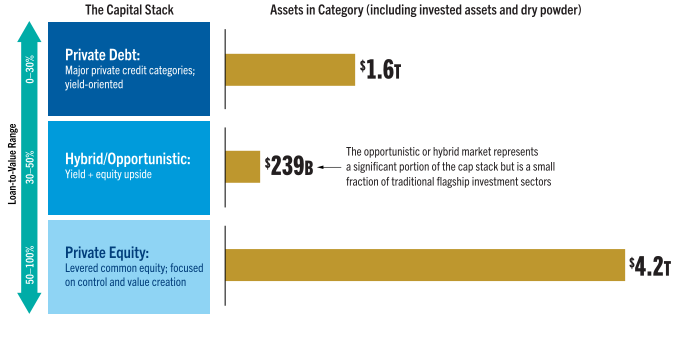
Source: Preqin, as of 12/31/24; Hybrid/Opportunistic category includes Hybrid, Hybrid Funds of Funds, Blended-Opportunistic, and Junior/Subordinated Debt categories, per Preqin’s classification. Golub Capital Analysis.
The essential expertise of the opportunistic credit manager we’re defining is the ability to identify, source, calibrate and execute credit opportunities across the capital structure. Deep ties to the participants, an understanding of their markets and the ability to credibly and creatively work a deal are indispensable virtues.
That means having deep proficiency and long history in all forms of debt, from senior loans down to mezzanine and from junior debt to structured equity solutions. It also means having close knowledge of the lender–borrower ecosystem and skill in discerning structural needs, imbalances and other opportunities across the different slices of a company’s capital structure.
An opportunistic credit manager should have:
From first- and second-lien loans to preferred equity and warrants
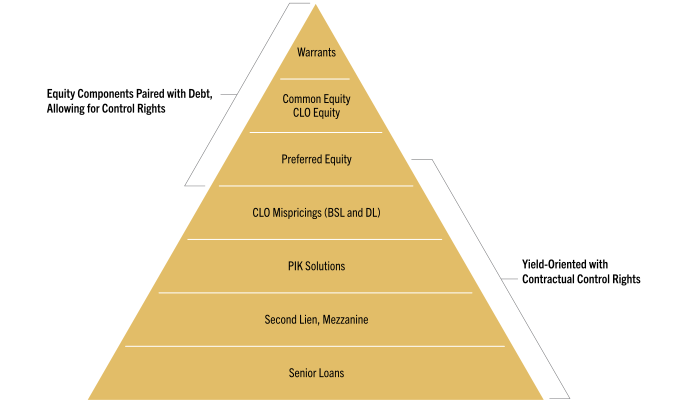
Source: Golub Capital; for illustrative purposes only.
It’s no surprise, from the contours we’ve laid out for this type of hybrid approach, that the return and risk profile of opportunistic credit is itself a carefully weighted blend of debt and equity: predictable, contractual income yield alongside structured equity upside. The returns fall in between the traditional direct lending and buyout categories, with a dominant component being robust cash yield with a high degree of consistency and substantial margin of safety.
Due to the varied mix of underlying strategies—from traditional senior-only direct lending to preferred and CLO equity—the investment characteristics tend to be diversified across an array of deal types (with low correlation between them). And given the counter-cyclical returns of some opportunistic investments, these exposures will include elements that may help diversify a client’s other private market exposures.
Taken together, these factors make opportunistic credit, as we define it, a completion strategy for a client’s comprehensive private market allocation. It helps fill the exposure gaps lying between traditional and less flexible PE on one hand and direct lending on the other. In this light, it could be construed as a natural adjunct to an investor’s PE allocation, delivering PE-like returns but with credit-like downside protection.
Opportunistic credit returns deliver a mix of contractual-based yield with equity upside
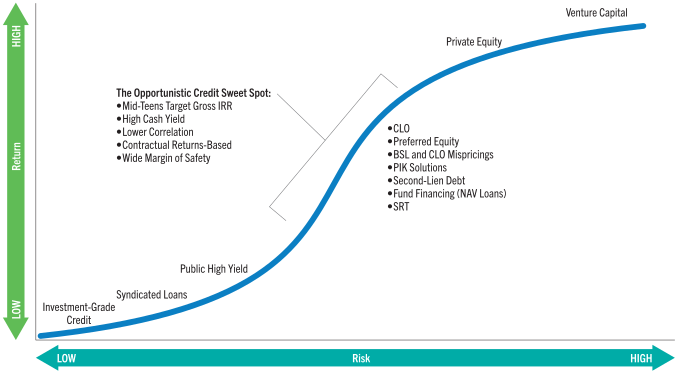
Source: Golub Capital; for illustrative purposes only.
In this document, the terms “Golub Capital” and “Firm” (and, in responses to questions that ask about the management company, general partner or variants thereof, the terms “Management Company” and “General Partner”) refer, collectively, to the activities and operations of Golub Capital LLC, GC Advisors LLC (“GC Advisors”), GC OPAL Advisors LLC (“GC OPAL Advisors”) and their respective affiliates or associated investment funds. A number of investment advisers, such as GC Investment Management LLC (“GC Investment Management”), Golub Capital Liquid Credit Advisors, LLC (Management Series) and OPAL BSL LLC (Management Series) (collectively, the “Relying Advisers”) are registered in reliance upon GC OPAL Advisors’ registration. The terms “Investment Manager” or the “Advisers” may refer to GC Advisors, GC OPAL Advisors (collectively the “Registered Advisers”) or any of the Relying Advisers. For additional information about the Registered Advisers and the Relying Advisers, please refer to each of the Registered Advisers’ Form ADV Part 1 and 2A on file with the SEC. Certain references to Golub Capital relating to its investment management business may include activities other than the activities of the Advisers or may include the activities of other Golub Capital affiliates in addition to the activities of the Advisers.
This document may summarize certain terms of a potential investment for informational purposes only. In the case of conflict between this document and the organizational documents of any investment, the organizational documents shall govern.
Information is current as of the stated date and may change materially in the future. Golub Capital undertakes no duty to update any information herein. Golub Capital makes no representation or warranty, express or implied, as to the accuracy or completeness of the information herein.
Views expressed represent Golub Capital’s current internal viewpoints and are based on Golub Capital’s views of the current market environment, which is subject to change. Certain information contained in these materials discusses general market activity, industry or sector trends or other broad-based economic, market or political conditions and should not be construed as investment advice. There can be no assurance that any of the views or trends described herein will continue or will not reverse. Forecasts, estimates and certain information contained herein are based upon proprietary and other research and should not be interpreted as investment advice, as an offer or solicitation, nor as the purchase or sale of any financial instrument. Forecasts and estimates have certain inherent limitations, and unlike an actual performance record, do not reflect actual trading, liquidity constraints, fees, and/or other costs. In addition, references to future results should not be construed as an estimate or promise of results that a client portfolio may achieve. Past events and trends do not imply, predict or guarantee, and are not necessarily indicative of, future events or results. Private credit involves an investment in non-publicly traded securities which may be subject to illiquidity risk. Portfolios that invest in private credit may be leveraged and may engage in speculative investment practices that increase the risk of investment loss.
This presentation has been distributed for informational purposes only, and does not constitute investment advice or the offer to sell or a solicitation to buy any security. This presentation incorporates information provided by third-party sources that are believed to be reliable, but the information has not been verified independently by Golub Capital. Golub Capital makes no warranty or representation as to the accuracy or completeness of such third-party information. No part of this material may be reproduced in any form, or referred to in any other publication, without express written permission.
Past performance does not guarantee future results.
All information about the Firm contained in this document is presented as of September 2025, unless otherwise specified.
The opportunistic fund category lacks definition and breeds confusion; we try to provide clarity by taking a credit-first view: Opportunistic credit sits at the center of a distinct universe of credit participants facing constantly shifting liquidity requirements and demand for debt capital. The breadth of this approach and its hybrid risk and return profile (with elements of both debt and equity) may help diversify and complete a comprehensive private market allocation.
"*" indicates required fields
