
As a leading direct lender in both the U.S. and Europe, we are often asked, “Which is better?” We believe both markets offer attractive characteristics.
Many of the same forces that gave shape to direct lending in the U.S. are also supporting its growth in Europe. The pace of market growth here (based on size, deal volume and other factors) suggests Europe is on the same path and developing at a similar pace as its U.S. direct lending sibling (see Exhibit 1).
While there are meaningful differences in character and approach across the two geographies, we find that the essential nature of the asset class does not change based on location. Importantly, we believe the same ingredients for manager success apply across both regions. And as we know from other asset class combinations, diversifying U.S. with European direct lending exposure can result in a more resilient allocation.
Direct Lending in the U.S. and Europe
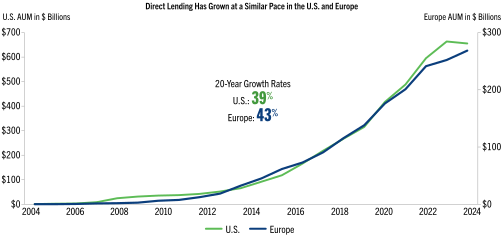
Source: Preqin. Data as of September 30, 2025.
Note: This chart tracks assets under management (“AUM”) in direct lending for fund managers located in the U.S. and Europe from December 31, 2004–September 30, 2025. Compound annual growth rate (“CAGR”) is calculated over a 20-year period from December 31, 2004–December 31, 2024.
Direct lending as an asset class grew out of a specific context in the U.S.: the emergence of non‑bank lenders as a key source of financing for private equity sponsors targeting middle market companies. But similar dynamics (regulatory constraints on traditional bank lending and the growth of private equity) have been developing in locations outside the U.S. for years, albeit more gradually. This has led to a considerable international market for private direct lending, with certain geographies—Europe, in particular—drawing keen investor attention.
In terms of economic opportunity, Europe’s GDP ($23 trillion) is near that of the U.S. ($28 trillion).¹ The two regions also share a number of important characteristics conducive to the growth of a direct lending ecosystem. Family‑owned small and middle market businesses make up almost two‑thirds of the European economy—even more than in the U.S.² Home‑grown and global private equity sponsors, the natural acquirers of these businesses, have proliferated in Europe, with assets growing more than seven‑fold from $167 billion in 2004 to over $1.2 trillion in 2024 (see Exhibit 2, left side).³ And while the two private credit markets have matured in parallel over the last two decades, European direct lending has grown at a slightly faster clip than its U.S. sibling, with many European issuers today favoring private over public financing options (see Exhibit 2, right side).
These trends point to two distinct but closely aligned direct lending environments, each shaped by local market structure and policy—but both supported by strong secular tailwinds.
The U.S. and European Direct Lending Ecosystem
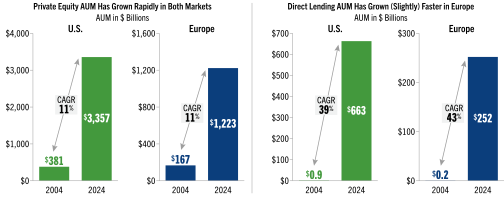
Source: Preqin. Data as of September 30, 2025 (left and right sides).
Note: Direct lending AUM encompasses senior, unitranche, subordinated and opportunistic private debt strategies, as well as assets held in closed-end private capital funds. Closed-end business development companies (“BDCs”) are included; open-end BDCs are excluded (right side).
While we believe European direct lending can be attractive, it faces some near‑term deficits relative to the U.S. Two key headwinds stand out: more competition from banks and more acute deal‑related frictions due to Europe’s stricter, more country‑specific legal and regulatory patchwork.
European banks, facing similar regulatory capital pressures as their U.S. counterparts, have ceded some ground to non‑bank lenders—but they are still powerfully present in the market for financing private equity‑backed companies in Europe. In the U.S., private direct lenders today dominate the financing of sponsor‑driven middle market buyouts: They are the source of around 80% of all middle market lending. In Europe, by contrast, banks today retain approximately 50% of sponsor‑originated Leverage Buyout (LBO) financing volume.⁴
Private lenders also show a strong preference for northern European jurisdictions over southern ones. Both the number of buyout deals and the percentage financed by private lenders decline as you move south. The UK, France and Germany lead in deal count, while the Nordics have the highest share of deals financed by private lenders. Private debt funds in France and Germany claim about a 50% share, while Italy and Spain lag, with typically just under 30% of deals in those areas funded by non‑bank lenders.⁵
The reason? Northern jurisdictions were earlier in allowing private debt funds to issue new loans without requiring a banking license, and they have generally been characterized by more lender‑friendly enforcement regimes. But it’s an increasingly dynamic market: 2025 saw $115 billion in direct lending deal volume in Europe across 1,357 transactions (up 23% and 11%, respectively, compared to the previous year).⁶ Northern climes still lead, but the rest of Europe shows steady growth. For example, Spain’s deal counts increased 35% year over year, and in Italy, non‑bank lenders provided financing for nearly 50% of in‑country buyout deals, up from an average of 19% in previous years (see Exhibit 3).⁷
The Progress of Direct Lending Across Europe
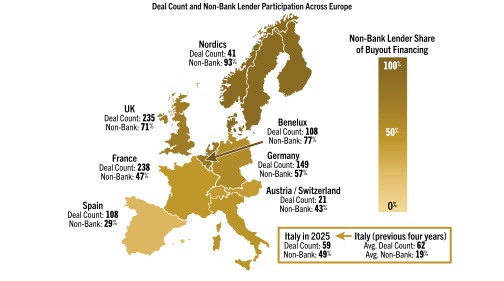
Source: Houlihan Lokey MidCap Monitor Europe Q4 2025.
A key difference between Europe and the U.S. rests on the varied conditions of their private market ecosystems and their role in fostering a more productive economy. European private equity as an industry has grown substantially, but it still lags the U.S. by more than half. European private equity AUM represents about 9% of GDP, vs. 17% in the U.S. (see Exhibit 4, left side).
Many see this as at least one of the factors explaining the continent’s slower economic growth in general. From 2002–2025, Europe’s real GDP growth lagged the U.S. by 0.8 percentage points annually, with 70% of the gap attributable to slower productivity gains.⁸ A new sense of urgency in closing this productivity gap is driving pan‑European policy revisions—a “competitiveness agenda” intended, in part, to stimulate private equity sponsor activity (and, as a consequence, embed greater productivity in their portfolio companies).
The regulatory effort in Europe seeks to prioritize private over public capital, luring more private equity sponsors (both local European managers and, increasingly, global GPs) and their operational expertise to professionalize the continent’s many family‑owned companies. And it’s working: Family‑to‑sponsor deals, which typically involve younger businesses not yet operating at scale, have lower multiples than other transaction types and have drawn avid sponsor engagement.
Family‑to‑sponsor (and sponsor‑to‑sponsor transactions of family‑owned businesses) constitute about four out of every five deals in Europe, a higher percentage than in the U.S.⁹
The effort has also attracted a greater number of non‑local private equity managers into the market. In 2025, 36% of all private equity activity (based on enterprise value) was driven by globally minded U.S.‑based sponsors (see Exhibit 4, right side).¹⁰ These firms remain true to their familiar U.S. modus operandi, even while doing business in Europe. They gravitate toward larger deals (more typically in TMT and Services), with average EBITDA of $100 million compared to EU‑based sponsors, who tend to pursue deals with average EBITDA of $30 million.¹¹ In fact, these U.S.-derived managers are driving market‑wide growth in the number of “jumbo” unitranche deals in Europe.¹²
Meanwhile, policymakers in Brussels are streamlining merger controls for both in‑country and cross‑border acquisitions. This is an effort to spur buy‑and‑build consolidation across sponsor portfolios (often enabled by specialized “delayed draw term loans” (DDTLs) provided by private debt managers) to accelerate revenue growth.¹³ This increase in regulatory harmonization, along with ongoing balance sheet sensitivities among banks, should accelerate the shift to private non‑bank financing for middle market buyouts.¹⁴
Europe Calls on (Global) Private Capital
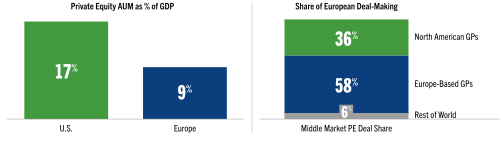
Source: McKinsey Global Private Markets Report 2026; MSCI Burgiss data as of Q4 2025 (left side).
Source: Gain.pro, The State of European Private Equity Report – H1 2026 (right side).
Despite operating within the same asset class, important differences remain between the U.S. and European direct lending markets. Europe reflects a more concentrated market structure today, with fewer private credit managers overall: Just five firms account for almost 50% of the market.¹⁵ There’s also less competitive crowding from public levered loan markets, which are smaller than in the U.S. and not as welcoming to unrated middle market borrowers. And while credit spreads have compressed globally across all forms of debt over the last several years, European private credit has consistently priced wider than U.S. markets (by about 50 bps) due to all the factors mentioned: fewer participants, less market saturation and less competition from public broadly syndicated loan (BSL) markets.¹⁶ Amid this shallower pool of capital and more limited competition, European buyouts tend to trade at lower entry multiples than those in the U.S.¹⁷
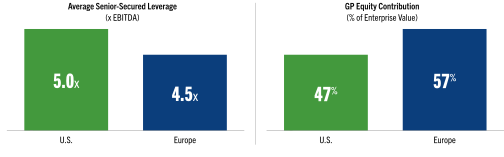
European deals, in general, are also more conservatively structured than their U.S. counterparts. In the market at large, and in our lending business, we find that EU buyouts typically trade with less leverage per transaction; on average, European LBOs have senior‑secured leverage of 4.5x vs. 5x in the U.S. (see Exhibit 5, left side). European buyout GPs also contribute higher equity per transaction than in the U.S. (57% vs. 47%), providing more cushion for lenders (see Exhibit 5, right side).
Another distinction worth citing is that there’s a higher percentage of sponsor participation in private credit deal flow in Europe than in the U.S. Around 80% of borrowers in the European direct lending market are sponsor‑backed. Among these private equity sponsors, those with UK or U.S. headquarters typically rank first or second, whether that’s measured by regional representation, participation by industry sector, enterprise value or deal count.¹⁸ This extensive (and global) GP participation is a welcome characteristic: It enables better manager–lender alignment and entails more scaffolded underwriting, providing an additional backstop in the case of potential credit stress. The resulting lower‑octane approach to the asset class is borne out in performance data, as we’ll see in the next section.
Less Filling, Same Taste
Source: Kroll StepStone U.S. and European LBO first lien outstanding issue monitor. Data as of September 30, 2025 (left side).
Source: Proskauer, Private Credit Insights Report; data as of December 31, 2025 (right side).
Sourcing valid performance data in private direct lending is notoriously difficult, and doing so across geographies to make credible comparisons is even harder. With that caveat, it’s important for investors to have some framing of the historical return and risk characteristics of the asset class and whether (and how) they differ by geography.
Our analysis suggests the performance characteristics of U.S. and European direct lending are remarkably similar.¹⁹ From a total return perspective, European direct lending has produced average annual returns of 9.0% since 2019, compared to 5.6% for European BSLs. These results rhyme with U.S. data, where we see a similar total return advantage for private direct lending over public loan markets.²⁰
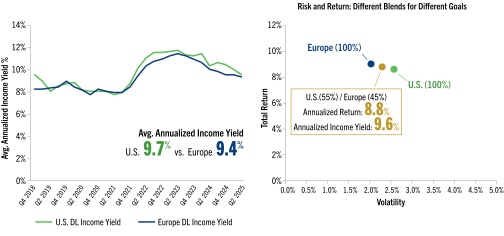
Comparing private direct lending across the two geographies, we see evidence of both convergence and heterogeneity. U.S. direct lending has a slim advantage in income yield (9.7% annualized vs. 9.4%), mostly attributable to slightly higher base rates in the U.S. over the limited period available for analysis (see Exhibit 6, left side). Meanwhile, quarterly total returns are closely aligned, with U.S. direct lending averaging 2.1% each quarter vs. 2.2% for European investors. On an annualized basis, that translates to a slight return advantage for European direct lending over this period (9.0% to 8.5%), achieved with modestly lower volatility.
These results present interesting portfolio construction opportunities for global investors. A simple market‑weighted combination (55% U.S. and 45% Europe) delivers a blended return of 8.8% over the period (see Exhibit 6, right side). If an allocator prizes income yield over total returns, she might tilt toward even higher U.S. exposure. With appropriate currency hedging in place, U.S. dollar‑oriented investors could benefit from both elevated U.S. base rates and higher European private credit spreads. European allocators could gain otherwise difficult access to local, high‑growth middle market companies and protection against potential USD depreciation. In sum, access to both geographies extends the opportunity set for allocators with various distinct goals, enabling them to build global portfolios with greater diversification and stronger resilience.
The Allocation Opportunity with European Direct Lending
Source: Lincoln Senior Debt Index and Lincoln European Senior Debt Index; data as of December 2025 (left and right sides).
Our years of experience in both markets tell us that U.S. and European direct lending constitute a single asset class with similar drivers and return characteristics. Yet important regional differences remain. Two examples may be worth referencing in closing.
International revenues constitute about 60% of European firms—about double the share we find among their U.S. peers.²¹ This brings inherent complexity, with most European lending programs typically requiring a multi‑currency debt solution.
Consider an example from our own history in Europe: A unitranche loan was initially funded in several currencies (USD, EUR, GBP and CHF) to repay the borrower’s existing local currency debt outstanding. After the deal’s close, currencies were re‑denominated to a 50/50 USD/EUR split to better match the future profitability of the company. We then layered on a DDTL structured to be drawn in either USD, EUR or GBP to allow the company flexibility to extend its platform through acquisition as needed. The lesson is that a true global lender must be able to accommodate full multi‑currency solutions and follow wherever the sponsor and company management seek to grow.
Another learning for private debt managers more familiar with the U.S. ecosystem: They will discover a wider variety of deals in Europe with less intense competition but still strong creditor protections. For example, a typical middle market borrower in the U.S. with $50 million in EBITDA would likely represent a more stable “national champion” company in Europe, with more consistent earnings and a lower entry multiple. But executing such a deal could be more complex. Successful European direct lending managers require appropriately staffed teams, established local presence, and the ability to navigate distinct restructuring and enforcement regimes in each region. These differences—and inefficiencies—offer a path to opportunity for flexible capital providers.
Despite these local nuances, the ingredients for manager success across the two geographies remain largely the same. The best lenders (in both Europe and the U.S.) will have a long history of partnership with the private equity sponsor community, regardless of where the headquarters sits. This type of direct sourcing of deal flow is the “without which not” for non‑bank lenders in Europe and can lead to rich and repeat incumbencies across the middle market borrower universe. The best global credit managers will have veteran teams in both origination and underwriting, with long experience stretching across multiple regions and credit cycles. Direct lending managers with these competitive advantages are well positioned to deliver consistently strong performance, regardless of deal domicile.
1. World Bank, World Development Indicators. Gross Domestic Product (current USD). EU + UK GDP is approximately $23 trillion; U.S. GDP is approximately $28 trillion. Reflects latest data available as of March 2026.
2. European Commission, Annual Report on European SMEs 2024-2025. SMEs represent about two-thirds of employment in the EU economy. Middle market companies account for about 33% of U.S. GDP. National Center for the Middle Market. Data as of May 2025.
3. Preqin analysis; data as of September 30, 2025.
4. U.S. data sourced from Bain Global Private Equity Report 2025. Data reflects the proportion of financing for middle market buyouts provided by direct lenders, where “middle market” is defined as issuers with revenue less than $500 million and total loan packages less than $500 million.
5. European market share for 2025 was derived from the Houlihan Lokey MidCap Monitor Europe Q4 2025.
6. Data from Debtwire, March 2026 report, “Direct Lending Braces for Redrawn Landscape.”
7. Houlihan Lokey MidCap Monitor Europe Q4 2025 and Debtwire.
8. Mario Draghi, The Future of European Competitiveness: A Competitiveness Strategy for Europe, Publications Office of the European Union, 2025.
9. The State of European Private Equity Report, H1 2026, Gain.pro. (page 38).
10. Gain.pro, Europe 250: Private Equity Investors in Europe, 2025 edition.
11. Gain.pro, Europe 250, 2025 edition.
12. Unitranche activity, common in the U.S., was quite robust in Europe during Q4 2025, with 166 of these jumbo deals closing in that quarter alone. The growth in unitranche lending reflects increasing appetite from international credit funds even in peripheral European countries, which historically have been dominated by bank-driven lending, Houlihan Lokey MidCap Monitor, Q1 2026.
13. Ibid. Sponsors are especially focused on portfolio value creation through buy-and-build strategies. Add-ons represent about two-thirds of all PE activity in Europe.
14. McFarlanes “Basel 3.1: Fuel to Further Accelerate the Growth of Private Credit?” September 2024. Also see Mario Draghi’s comment: “Europe relies excessively on bank financing… banks are typically ill-equipped to finance innovative companies. A financial structure that favors innovation should be at least partly equity financed and/or have long-term debt financing.” Data as of September 2024.
15. Cliffwater research and Preqin.
16. KBRA DLD.
17. Pitchbook, European & US Private Credit and LBO Financing Trends, 2025; Grant Thornton, Leveraged Loan Market Overview, February 2025.
18. Gain.pro, Europe 250, 2025 edition. In league tables for buyout activity, U.S. sponsors are ranked first in terms of total enterprise value ($420 billion) and third by deal count. U.S. managers are especially present in the UK and Italy, but tend to be under-represented in the Benelux and Nordics.
19. This information is based on the Lincoln European Senior Debt Index for private direct lending and the Morningstar European Leveraged Loan Index for the European BSL market. Both indices cover the period from Q1 2019–Q3 2025. The Lincoln’s European Senior Debt Index includes all European private credit borrowers for which Lincoln provides recurring valuations. All valuations conform with IFRS and/or US GAAP and fair value principles.
20. The comparison of European and U.S. direct lending is based on the Lincoln European Senior Debt Index and the Lincoln Senior Debt Index (reflecting the U.S. market) for the period 2019–2025.
21. S&P Dow Jones Indices; STOXX Europe 600 constituent revenue disclosures, aggregated 2024–2025.
In this document, the terms “Golub Capital” and “Firm” (and, in responses to questions that ask about the management company, general partner or variants thereof, the terms “Management Company” and “General Partner”) refer, collectively, to the activities and operations of Golub Capital LLC, GC Advisors LLC (“GC Advisors”), GC OPAL Advisors LLC (“GC OPAL Advisors”) and their respective affiliates or associated investment funds. A number of investment advisers, such as GC Investment Management LLC (“GC Investment Management”), Golub Capital Liquid Credit Advisors, LLC (Management Series), Golub Capital Liquid Credit Advisors, LLC (Management Series Sequoia) and OPAL BSL LLC (Management Series) (collectively, the “Relying Advisers”) are registered in reliance upon GC OPAL Advisors’ registration. The terms “Investment Manager” or the “Advisers” may refer to GC Advisors, GC OPAL Advisors (collectively the “Registered Advisers”) or any of the Relying Advisers. For additional information about the Registered Advisers and the Relying Advisers, please refer to each of the Registered Advisers’ Form ADV Part 1 and 2A on file with the SEC.
Certain references to Golub Capital relating to its investment management business may include activities other than the activities of the Advisers or may include the activities of other Golub Capital affiliates in addition to the activities of the Advisers. This document may summarize certain terms of a potential investment for informational purposes only. In the case of conflict between this document and the organizational documents of any investment, the organizational documents shall govern.
Information is current as of the stated date and may change materially in the future. Golub Capital undertakes no duty to update any information herein. Golub Capital makes no representation or warranty, express or implied, as to the accuracy or completeness of the information herein.
Views expressed represent Golub Capital’s current internal viewpoints and are based on Golub Capital’s views of the current market environment, which is subject to change. Certain information contained in these materials discusses general market activity, industry or sector trends or other broad‑based economic, market or political conditions and should not be construed as investment advice. There can be no assurance that any of the views or trends described herein will continue or will not reverse. Forecasts, estimates and certain information contained herein are based upon proprietary and other research and should not be interpreted as investment advice, as an offer or solicitation, nor as the purchase or sale of any financial instrument. Forecasts and estimates have certain inherent limitations, and unlike an actual performance record, do not reflect actual trading, liquidity constraints, fees, and/or other costs. In addition, references to future results should not be construed as an estimate or promise of results that a client portfolio may achieve. Past events and trends do not imply, predict or guarantee, and are not necessarily indicative of, future events or results.
Private credit involves an investment in non‑publicly traded securities which may be subject to illiquidity risk. Portfolios that invest in private credit may be leveraged and may engage in speculative investment practices that increase the risk of investment loss.
This presentation has been distributed for informational purposes only, and does not constitute investment advice or the offer to sell or a solicitation to buy any security. This presentation incorporates information provided by third‑party sources that are believed to be reliable, but the information has not been verified independently by Golub Capital. Golub Capital makes no warranty or representation as to the accuracy or completeness of such third‑party information. No part of this material may be reproduced in any form, or referred to in any other publication, without express written permission.
Past performance does not guarantee future results.
All information about the Firm contained in this document is presented as of June 2026, unless otherwise specified.
A number of investment advisers, such as GC Investment Management LLC (“GC Investment Management”), Golub Capital Liquid Credit Advisors, LLC (Management Series), Golub Capital Liquid Credit Advisors, LLC (Management Series Sequoia) and OPAL BSL LLC (Management Series) (collectively, the “Relying Advisers”) are registered in reliance upon GC OPAL Advisors’ registration.
"*" indicates required fields