
In private direct lending, references to published default rates can vary widely—whether from traditional rating agencies, valuation firms or legal groups. We consider key differences in the very definition of “default” across different providers and the various methodologies used to measure them. The reality is that default can mean different things in different contexts and across different industry participants. We conclude that investors should always inquire: Whose default is it?
To start, investors should recognize a clear distinction between the nature of public and private credit and the various methodologies used to measure credit stress and default across these two areas. (See Exhibit 1)
Rating agencies maintain broad coverage of the syndicated public loan universe, with clear and common criteria for assessing these securities, and provide a consistent, industry-wide view. In contrast, coverage of private credit is less comprehensive, with more limited tracking of these illiquid, non-traded loans and different criteria applied to their credit estimates.
The very distinction between a credit rating and a credit estimate is worth noting. Much of the difference in analyst coverage across public and private credit is due to the opacity of the private lending landscape, where information is less transparent and accessible. In a word, it’s private.
As a result, it’s easier to establish a consensus pool of loans and apply a consistent set of criteria to assess these loans in the public space. In private credit, however, the pool of loans readily available to any one rating agency will vary based on its own loan book and level of access.
The differences extend also to the absence of market pricing for most private loans—an important indicator of credit stress—since these securities are not publicly traded. Instead, valuations on private debt are provided, loan by loan, by the individual lenders themselves, often assessed or corroborated by third-party valuation firms.
Even when a credit estimate is available on a private loan, it must be understood as distinct, in terms of methodology and data availability, from a public issuer rating. All this renders side-by-side comparison of public and private credit default rates not only complicated but potentially misleading.
| Public Credit | Private Credit | |
|---|---|---|
| Rating Agency Coverage | Broad coverage of syndicated loan universe; all rating agencies provide credit “ratings” | Limited tracking of direct lending issuers and credits; some rating agencies provide credit “estimates” |
| Information Access | Information generally accessible on syndicated loans with transparent data | Private loan information that is both opaque and not readily available |
| Loan Pool | More clearly defined market-standard pool of loans for broad analyst engagement | No consensus on or equally accessible pool of loans for analyst measurement |
| Market Pricing | Generally available market pricing on most syndicated loans | No public venue for pricing; select loans marked quarterly by third-party valuation firms |
Source: Golub Capital analysis and LSTA publication: “Why is there a disparity in private credit default rates?” May 15, 2024. The major indexes and ratings agencies use different methodologies and definitions to measure default. S&P Capital includes selective defaults, including PIK conversion or deferred payment, amend to extend, and amortization waivers. Conventional default includes only missed interest or principal payment, distressed exchange, and bankruptcy filing. Different ratings agencies also use different time periods for their default calculations: Fitch, S&P and KBRA calculate their default rates on a trailing 12-month basis, updated monthly, so they reflect the size of the universe 12 months prior; Proskauer and Lincoln consider defaults on a point-in-time quarterly basis.
Even within the private credit space, there is no uniformity in how default is defined or measured.
Across the array of industry participants covering private credit issuers—which includes valuation firms, rating agencies and law firms—each draws from their own unique set of loan documents. As a result, no single source can reliably represent industry-wide credit stress. Further, some coverage analysts (such as Lincoln and Proskauer) include covenant breaches in their definition of default, while others do not. That’s an important distinction. (See Exhibit 2)
Breaching a maintenance covenant, while technically a form of default, is not construed as a conventional measure of default. True default is far more grave; it usually involves a failure to pay principal or interest or company insolvency. Including covenant breaches can skew default rates—especially for smaller firms that are more likely to have such covenants. Larger firms, which tend not to have maintenance covenants, may appear less stressed simply due to this methodological bias.
Finally, other inconsistencies exist beyond the inclusion (or not) of covenant breaches. Some firms may include amendments, amortization waivers, payment-in-kind (PIK) conversions or distressed exchanges. While all of these actions may represent early signs of credit stress, they do not indicate the same degree of stress, and their selective inclusion or exclusion only adds to the disparity in measurement. Again, we must ask: Whose default is it?
| Agency | Universe | Includes Covenant Defaults | Types of “Selective” Defaults Included |
|---|---|---|---|
| Fitch | Provides private ratings on 1,200 middle market loans | No |
|
| S&P | Provides credit estimates on 2,800 borrowers | No |
|
| Proskauer | Tracks 980 senior secured and unitranche loans | Yes |
|
| Lincoln | Tracks 500 middle market direct loans | Yes |
|
| KBRA | Index contains 2,400 companies financed by direct loans | No |
|
* The types of “selective” defaults included do not meet the definition of “conventional” defaults.
Source: Golub Capital analysis and LSTA “Why is there a disparity in private credit default rates?” May 15, 2024.
What does this mean for investors seeking to understand the level of true default risk in private credit? As shown in Exhibit 3, the inclusion of selective measures of default can significantly impact their perception of potential risk. Both metrics are provided by the same rating agency, but two things stand out.
First, selective defaults tend to be significantly higher than the conventional payment default because they include more and earlier indicators of stress. Second, the selective default line is more sensitive, rising earlier and more sharply than conventional measures of default.
This suggests that selective default metrics can be a useful leading indicator of future stress. However, they can also amplify perceived risk. While they offer early detection value, that signal must be interpreted in a broader, more informed context.
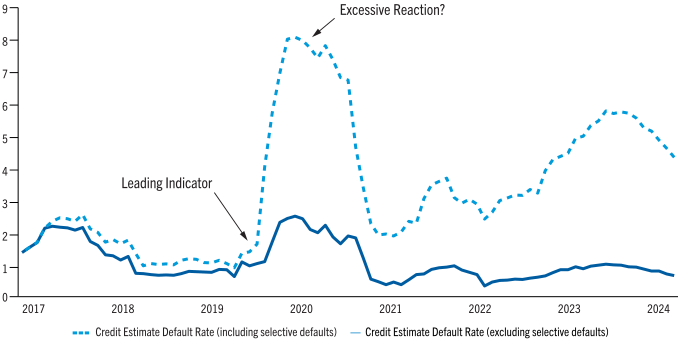
1. Golub Capital Analysis and S&P Capital; Selective defaults for S&P Capital include PIK conversion or deferred payment, amend to extend, and amortization waivers. Conventional default includes only missed interest or principal payment, distressed exchange and bankruptcy filing.
Consider three distinct measures of selective default rates from Fitch, S&P and Lincoln International, all measured at the end of Q3 2024.
Because each firm has its own distinct—possibly overlapping, but not identical—pool of loans and applies its own definition of selectivity in determining default, we’re left with highly disparate measures of default in the private credit space.
Fitch calculates its default rate based on a pool of approximately 1,200 loans. It’s an annualized figure, based on nine months of available data, marking it as a relatively new data source. S&P uses a broader base of around 2,800 loans and applies its own selective default methodology, which is similar to but not fully aligned with Fitch’s approach.
Meanwhile, Lincoln, which reviews about 500 direct loans as part of its valuation work, employs a distinct methodology centered on covenant defaults.
The result is more confusion than clarity, with default rates sometimes varying substantially across different organizations. The only way to navigate through this relativity in the representation of private market credit stress is to understand the distinct methodologies applied in each case.
7%
Based on 1,200 loans; 9 months annualized; uncured payment default and distressed exchanges
Fitch
(Includes Selective Defaults)2
4.3%
Based on 2,800 loans; TTM; includes selective default metrics
S&P
(Includes Selective Defaults)3
2.2%
Based on ~500 loans; includes covenant defaults; loans defaulted in current quarter plus those uncured from previous quarters
Lincoln
(Includes Covenant Breaches)4
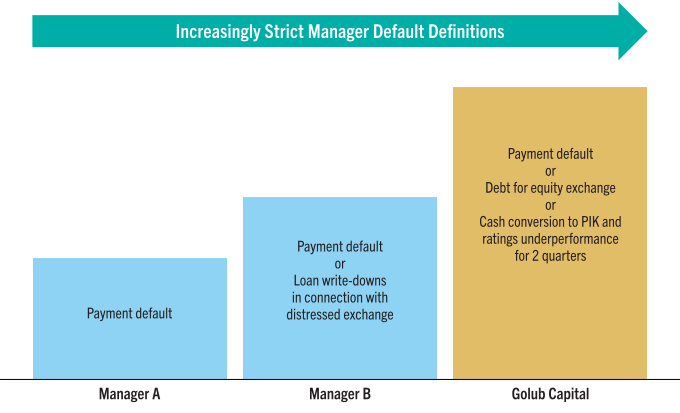
We pursue the disparities of default measurement beyond public vs. private and private vs. private contexts, down to the manager level. Here, too, we find a wide range of selectivity and varying degrees of strictness in the application of different definitions of default.
These differences are often buried in the footnotes of credit manager presentations. Some rely on a simple payment default metric, which is a conventional measure but a relatively narrow approach. Others expand their definition to include certain write-downs associated with distressed exchanges. Some adopt even more conservative criteria, including persistent ratings underperformance or PIK conversion. (See Exhibit 5)
These discrepancies can complicate due diligence and make manager-to-manager comparisons difficult. Our advice to investors remains the same. Always ask: Whose default is it?
In this document, the terms “Golub Capital” and “Firm” (and, in responses to questions that ask about the management company, general partner or variants thereof, the terms “Management Company” and “General Partner”) refer, collectively, to the activities and operations of Golub Capital LLC, GC Advisors LLC (“GC Advisors”), GC OPAL Advisors LLC (“GC OPAL Advisors”) and their respective affiliates or associated investment funds. A number of investment advisers, such as GC Investment Management LLC (“GC Investment Management”), Golub Capital Liquid Credit Advisors, LLC (Management Series) and OPAL BSL LLC (Management Series) (collectively, the “Relying Advisers”) are registered in reliance upon GC OPAL Advisors’ registration. The terms “Investment Manager” or the “Advisers” may refer to GC Advisors, GC OPAL Advisors (collectively the “Registered Advisers”) or any of the Relying Advisers. For additional information about the Registered Advisers and the Relying Advisers, please refer to each of the Registered Advisers’ Form ADV Part 1 and 2A on file with the SEC. Certain references to Golub Capital relating to its investment management business may include activities other than the activities of the Advisers or may include the activities of other Golub Capital affiliates in addition to the activities of the Advisers. This document may summarize certain terms of a potential investment for informational purposes only. In the case of conflict between this document and the organizational documents of any investment, the organizational documents shall govern.
Information is current as of the stated date and may change materially in the future. Golub Capital undertakes no duty to update any information herein. Golub Capital makes no representation or warranty, express or implied, as to the accuracy or completeness of the information herein.
Views expressed represent Golub Capital’s current internal viewpoints and are based on Golub Capital’s views of the current market environment, which is subject to change. Certain information contained in these materials discusses general market activity, industry or sector trends or other broad-based economic, market or political conditions and should not be construed as investment advice. There can be no assurance that any of the views or trends described herein will continue or will not reverse. Forecasts, estimates and certain information contained herein are based upon proprietary and other research and should not be interpreted as investment advice, as an offer or solicitation, nor as the purchase or sale of any financial instrument. Forecasts and estimates have certain inherent limitations, and unlike an actual performance record, do not reflect actual trading, liquidity constraints, fees, and/or other costs. In addition, references to future results should not be construed as an estimate or promise of results that a client portfolio may achieve. Past events and trends do not imply, predict or guarantee, and are not necessarily indicative of, future events or results. Private credit involves an investment in non-publicly traded securities which may be subject to illiquidity risk. Portfolios that invest in private credit may be leveraged and may engage in speculative investment practices that increase the risk of investment loss.
This presentation has been distributed for informational purposes only, and does not constitute investment advice or the offer to sell or a solicitation to buy any security. This presentation incorporates information provided by third-party sources that are believed to be reliable, but the information has not been verified independently by Golub Capital. Golub Capital makes no warranty or representation as to the accuracy or completeness of such third-party information. No part of this material may be reproduced in any form, or referred to in any other publication, without express written permission.
Past performance does not guarantee future results.
All information about the Firm contained in this document is presented as of January 2026, unless otherwise specified.
The Morningstar Indexes are the exclusive property of Morningstar, Inc. Morningstar, Inc., its affiliates and subsidiaries, its direct and indirect information providers and any other third party involved in, or related to, compiling, computing or creating any Morningstar Index (collectively, “Morningstar Parties”) do not guarantee the accuracy, completeness and/or timeliness of the Morningstar Indexes or any data included therein and shall have no liability for any errors, omissions, or interruptions therein. None of the Morningstar Parties make any representation or warranty, express or implied, as to the results to be obtained from the use of the Morningstar Indexes or any data included therein.
“Cliffwater,” “Cliffwater Direct Lending Index,” and “CDLI” are trademarks of Cliffwater LLC. The Cliffwater Direct Lending Indexes (the “Cliffwater Indexes”) and all information on the performance or characteristics thereof (“Cliffwater Index Data”) are owned exclusively by Cliffwater LLC, and are referenced herein under license. Neither Cliffwater nor any of its affiliates sponsor or endorse, or are affiliated with or otherwise connected to, Golub Capital, or any of its products or services. All Cliffwater Index Data is provided for informational purposes only, on an “as available” basis, without any warranty of any kind, whether express or implied. Cliffwater and its affiliates do not accept any liability whatsoever for any errors or omissions in the Cliffwater Indexes or Cliffwater Index Data, or arising from any use of the Cliffwater Indexes or Cliffwater Index Data, and no third party may rely on any Cliffwater Indexes or Cliffwater Index Data referenced in this report. No further distribution of Cliffwater Index Data is permitted without the express written consent of Cliffwater. Any reference to or use of the Cliffwater Index or Cliffwater Index Data is subject to the further notices and disclaimers set forth from time to time on Cliffwater’s website.
"*" indicates required fields